Time Management and Prioritisation
Reducing Overwhelm by Working Smarter, Not Harder

Reducing Overwhelm by Working Smarter, Not Harder
You start every day with good intentions. Today will be different. Today you'll be organised, productive, focused. You write the to-do list — and it's already too long before you've finished writing it. Emails need answering. The report is overdue. You promised to call the dentist three weeks ago. The house needs cleaning. You need to buy a birthday present. There's a meeting at two that you haven't prepared for. Your child's school wants a form filled in by tomorrow. And somewhere in the background, the persistent, nagging feeling that you're forgetting something important.
By mid-morning, you've answered twelve emails, started three tasks without finishing any of them, been interrupted four times, and added two new items to the list. By evening, you're exhausted but can't point to a single meaningful thing you accomplished. The list is longer than it was this morning. And the thought arrives, as it does most nights: I just can't keep up.
This isn't a moral failing. It's not evidence that you're lazy, disorganised, or incapable. It's what happens when the demands on your time and attention exceed your capacity to manage them — and when the strategies you're using to cope are making the problem worse rather than better.
Time management isn't about doing more things. It's about doing the right things — and letting go of the belief that you should be able to do everything.
Time management might sound like a productivity topic rather than a psychological one. But the link between how you manage your time and how you feel is direct and powerful.
Chronic overwhelm — the sense that there's always too much to do and never enough time — is one of the most common contributors to anxiety, stress, and burnout. It generates a permanent low-level state of activation: the sympathetic nervous system stays engaged, cortisol stays elevated, and the cognitive resources needed for clear thinking, decision-making, and emotional regulation are consumed by the sheer volume of competing demands.
The psychological effects are predictable. Anxiety increases because the undone tasks generate a constant background hum of threat. Self-criticism increases because you judge yourself for not being productive enough. Sleep suffers because your mind rehearses tomorrow's list at 2am. Relationships suffer because you're always busy, always stressed, always somewhere else mentally even when you're physically present. And the irony deepens: the more overwhelmed you become, the less effectively you manage your time, which creates more overwhelm.
CBT recognises that the problem isn't just the objective volume of demands — it's also the cognitive patterns that amplify the overwhelm and prevent effective prioritisation.
You start every day with good intentions. Today will be different. Today you'll be organised, productive, focused. You write the to-do list — and it's already too long before you've finished writing it. Emails need answering. The report is overdue. You promised to call the dentist three weeks ago. The house needs cleaning. You need to buy a birthday present. There's a meeting at two that you haven't prepared for. Your child's school wants a form filled in by tomorrow. And somewhere in the background, the persistent, nagging feeling that you're forgetting something important.
By mid-morning, you've answered twelve emails, started three tasks without finishing any of them, been interrupted four times, and added two new items to the list. By evening, you're exhausted but can't point to a single meaningful thing you accomplished. The list is longer than it was this morning. And the thought arrives, as it does most nights: I just can't keep up.
This isn't a moral failing. It's not evidence that you're lazy, disorganised, or incapable. It's what happens when the demands on your time and attention exceed your capacity to manage them — and when the strategies you're using to cope are making the problem worse rather than better.
Time management isn't about doing more things. It's about doing the right things — and letting go of the belief that you should be able to do everything.

Overwhelm is amplified when tasks live in your head rather than on paper. Your mind is not designed to be a storage system — it's designed to be a processing system. When you try to hold dozens of tasks in memory, your brain treats each one as an open loop, generating a low-level anxiety signal for every uncompleted item.
The solution is simple: get everything out of your head and onto paper (or a screen). Write down every task, commitment, obligation, and nagging thought — without filtering, organising, or judging. Just dump it all out.
The act itself is often remarkably calming. The list might be long, but it's finite. It's no longer an amorphous cloud of everything-that-needs-doing. It's a concrete, bounded set of items that you can actually work with.
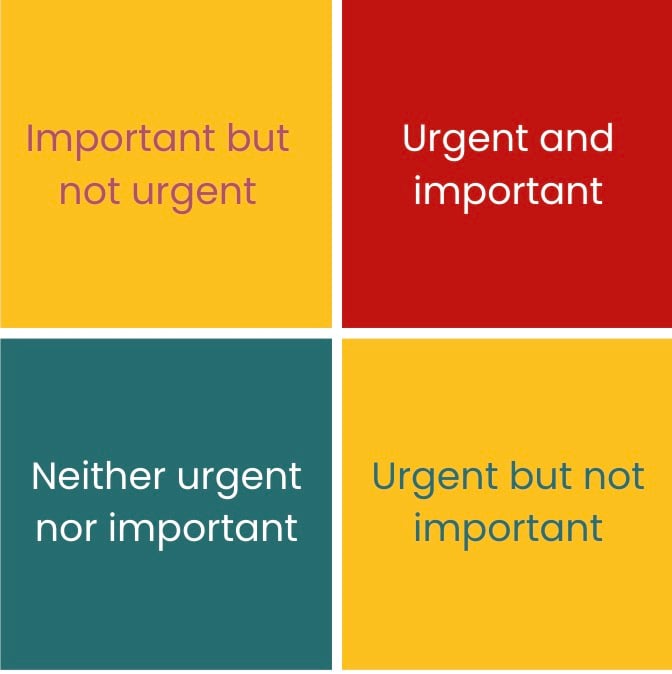
Once you have your list, sort each item into one of four categories based on two dimensions: urgency and importance.
Urgent and important: These need your attention now. A deadline today. A health issue. A crisis at work. Do these first.
Important but not urgent: These are the tasks that matter most for your long-term wellbeing, goals, and values — but they don't scream for attention because they don't have immediate deadlines. Exercise. Relationship building. Career development. Strategic planning. Self-care. These are the tasks that overwhelm consistently pushes aside, and they're the ones that make the biggest difference to your life. Schedule these deliberately.
Urgent but not important: These feel pressing but don't actually contribute to your goals or values. Many emails. Some meetings. Other people's emergencies that aren't genuinely yours. Delegate these where possible, or handle them quickly without letting them consume your best energy.
Neither urgent nor important: These are the time-fillers — the tasks and activities that don't contribute meaningfully to anything but somehow absorb hours. Excessive social media scrolling. Reorganising things that don't need reorganising. Attending meetings that don't require your presence. Eliminate or drastically reduce these.
The key insight of this matrix is that most people spend their time on urgent tasks (whether important or not) and neglect important-but-not-urgent tasks. Reversing this pattern — deliberately protecting time for what matters most — is the single most impactful change you can make.
Instead of facing a twenty-item to-do list each morning — which practically guarantees overwhelm — identify the three most important tasks for the day. Not the three most urgent. The three most important. The three that, if completed, would make the day feel genuinely productive regardless of what else happens.
Write them down. Do them before you do anything else. Protect them from interruption. This doesn't mean you ignore everything else. It means you prioritise what matters before the day's demands consume your attention. If you complete your three important tasks and nothing else, the day was a success. Everything beyond that is a bonus.
Vague plans — "I'll work on the report this afternoon" — rarely survive contact with reality. Specific plans — "I'll work on the report from 2pm to 3:30pm at my desk with notifications off" — are significantly more likely to be executed.
Time blocking means assigning specific tasks to specific blocks of time in your calendar. During that block, you work on that task and nothing else. No email. No phone. No "just quickly doing this other thing."
The technique works because it removes the constant decision-making about what to do next — which is itself a significant source of mental fatigue. When it's 2pm, you don't need to decide what to work on. The decision was already made. You just need to follow through.
Context-switching — jumping between different types of tasks — is cognitively expensive. Every time you switch from writing to email to planning to a phone call, your brain needs to reload the relevant mental context, which costs time and energy.
Batching similar tasks together reduces this switching cost. Answer all emails in one dedicated block rather than throughout the day. Make all phone calls in a single session. Do all administrative tasks in one batch.
This isn't always possible — some days are fragmented by meetings and unpredictable demands. But where you have control over your schedule, batching creates more focused, efficient, and less fatiguing work periods.
One of the most common planning errors is assuming that tasks will take exactly as long as you estimate and that nothing unexpected will arise. Both assumptions are almost always wrong.
Build buffer time into your schedule — gaps between commitments, unallocated blocks, margins for the unexpected. If you schedule every minute of your day with no slack, a single delay or interruption cascades through the entire schedule, creating stress and a sense of falling behind.
A good rule of thumb: plan to use about 60-70% of your available time. The remaining 30-40% absorbs the inevitable overruns, interruptions, and unexpected tasks that every day brings. This isn't wasted time — it's the difference between a schedule that works in reality and one that only works in theory.
If a task will take less than two minutes, do it immediately rather than adding it to your list. Sending a brief reply. Filing a document. Making a quick decision. The cognitive cost of tracking and managing tiny tasks often exceeds the cost of simply completing them.
This rule prevents small items from accumulating into an intimidating backlog and reduces the number of open loops your brain is tracking.
This is the hardest skill for many people, and the most important. You cannot manage your time effectively if you cannot control what goes on your list.
Saying no doesn't require rudeness or elaborate justification. Simple, honest responses work: "I don't have capacity for that right now." "I can't take that on this week, but I could look at it next month." "That's not something I'm able to help with, but here's someone who might be."
If saying no feels impossible, start with "not now." Deferring a request isn't declining it — it's managing it. And the practice of deferring builds the muscle that eventually allows you to decline when that's what's genuinely needed.
The ultimate lesson of time management isn't about efficiency. It's about choice. You will never have enough time to do everything. That's not a problem to be solved — it's a reality to be accepted. The question isn't "how do I fit everything in?" It's "given that I can't fit everything in, what will I choose?"
This reframe is liberating, though it doesn't always feel that way at first. It means accepting that some things will go undone. Some emails will wait. Some opportunities will be missed. Some tasks will be imperfect. And that's not failure — it's the necessary consequence of having priorities.
The people who manage their time most effectively aren't the ones who do the most. They're the ones who are clearest about what matters — and most willing to let go of what doesn't.

Overwhelm isn't caused by having too many tasks — it's caused by not having a system for deciding what matters most.
Effective time management starts with getting everything out of your head and onto paper, then sorting ruthlessly by importance rather than urgency.
Protect time for the tasks that genuinely matter. Use specific plans rather than vague intentions. Build buffer into your schedule. Learn to say no — or "not now" — without guilt. And accept that the goal isn't to do everything.
The goal is to do the right things, consistently, and to make peace with the fact that some things will remain undone. That's not failure. That's focus. But left unchecked, they fuel anxiety, depression, anger, and low self-esteem.
The antidote is awareness: once you can name a distortion, you can question it, and once you can question it, it loses much of its power over your emotions and your life.