
Your Cart
Loading

Thought Record Worksheet


From Harmless Flies To Existential Threat in 10 seconds

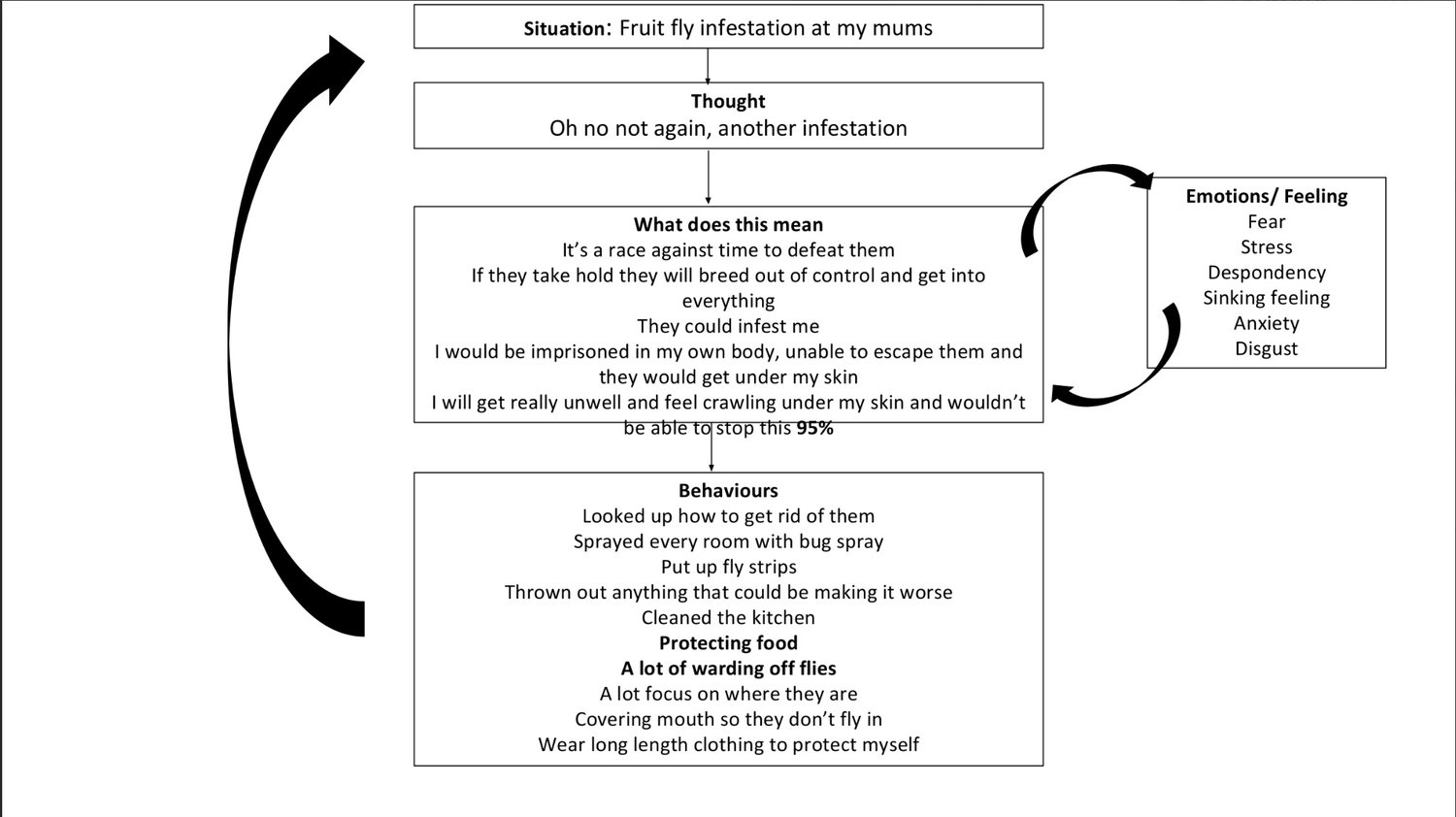
Here is an example of how someone who is preoccupied with a fear of being infested by parasites can be triggered by a few fruit flies that have appeared in the kitchen overnight. Notice how, even though the cause was most likely an over-ripe piece of fruit, the person's first automatic thought (that it's an infestation) jumps straight to a worse-case conclusion, which rapidly triggers more catastrophic thinking, resulting in a vicious cycle of hypervigilance, anxiety, stress, and unhelpful OCD behaviours.
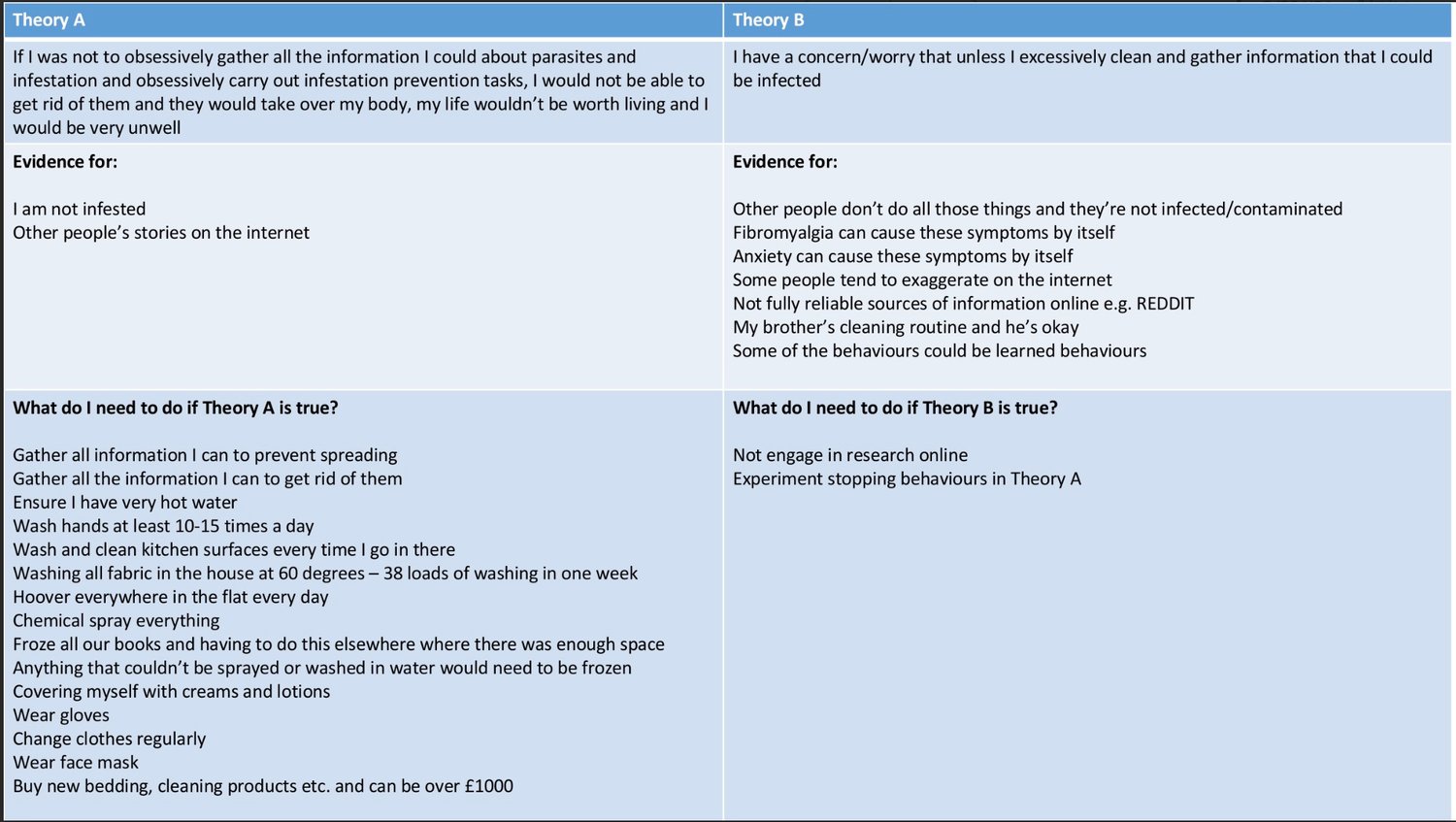
Theory A vs Theory B

If you were to apply the Theory A vs Theory B method to the same situation, it might look something like this:
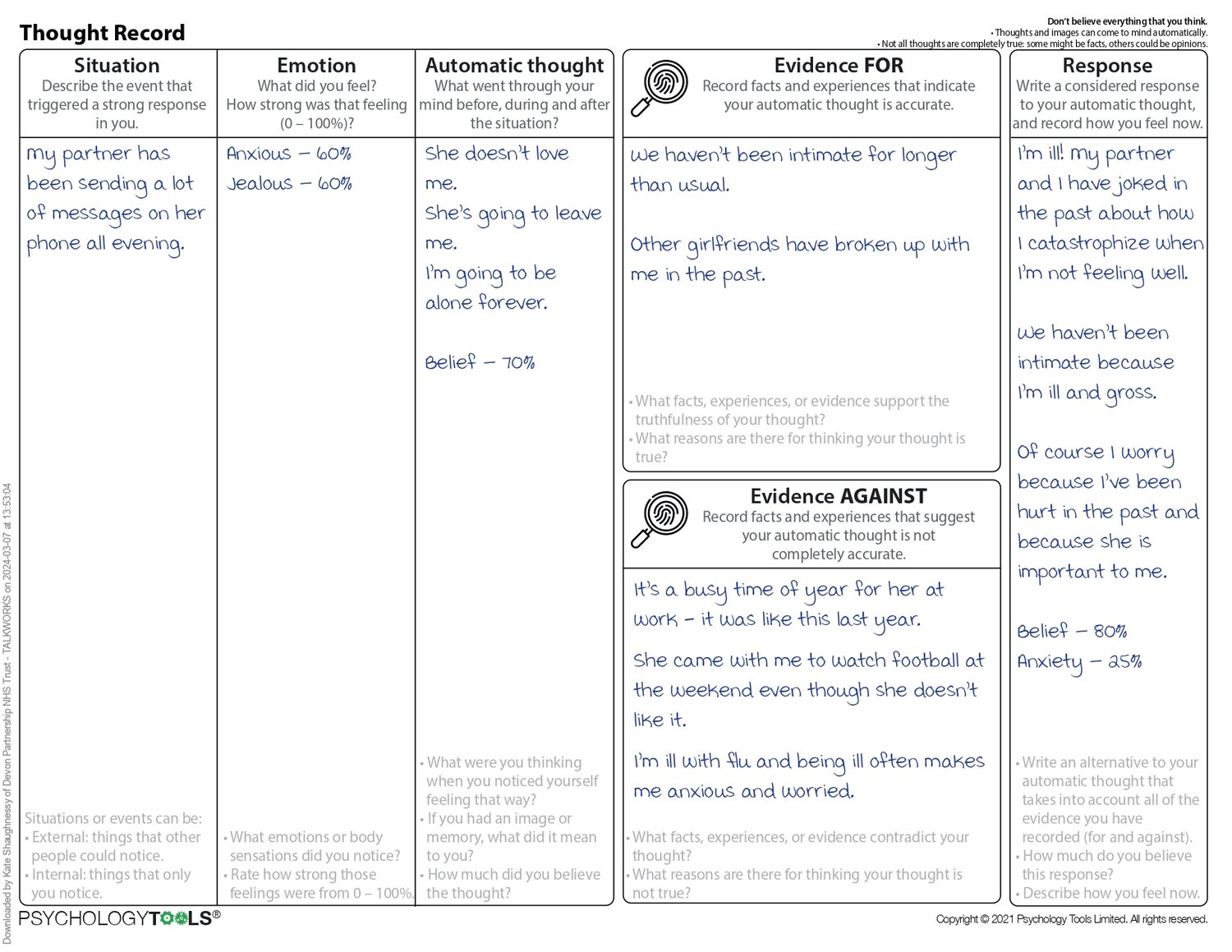
Thought Record Worksheet

Thought Record Worksheet

Cognitive Behavioural Therapy

A structured tool to help you identify, examine, and challenge unhelpful automatic thoughts. By slowing down your thinking and looking at the evidence, you can begin to develop more balanced, compassionate perspectives — and reduce the emotional distress that unhelpful thought patterns can cause.

🧠 Identify

Recognise the automatic thought and the situation that triggered it

🔍 Examine

Look at the evidence for and against the thought objectively

⚖️ Challenge

Develop a more balanced, helpful alternative perspective

🌿 Reflect

Notice how your emotions and mood shift after reframing

How to Use This Worksheet

Work through each step in order, taking your time with each section. There are no right or wrong answers — this is a private space for honest self-reflection. Your therapist may review this with you, or you may complete it independently between sessions.

1

Describe the Situation

Write down the specific event, memory, or trigger. Stick to the facts — where were you, what happened, who was there? Keep this section neutral and descriptive, without interpretation.

2

Identify Your Emotions

Name the emotions you felt (e.g. anxious, ashamed, angry, sad). Rate the intensity of each emotion from 0–100%. It is helpful to list several emotions — they often overlap.

3

Spot the Automatic Thought

What thoughts went through your mind? What did the situation mean to you about yourself, others, or the future? Circle the hot thought — the one that felt most distressing.

4

Examine the Evidence

List evidence that supports the hot thought, then evidence that does not support it. Try to be a fair witness to yourself — as if you were examining a friend's situation.

5

Develop a Balanced Thought

Based on all the evidence, write a more balanced alternative. This is not about positive thinking — it is about accurate, compassionate thinking. Rate how much you believe it (0–100%).

6

Re-rate Your Emotions

Return to the emotions you listed in Step 2. Re-rate their intensity now (0–100%). Notice any shifts — even small changes are meaningful and worth acknowledging.

💡 Reflection Prompts: What would you say to a close friend in this situation? Is there another way to interpret what happened? What thinking patterns do you notice (e.g. catastrophising, mind-reading, all-or-nothing thinking)?

My Thought Record

Complete This Section In Your Own Time

Use the spaces below to work through a recent situation that caused you distress. Take your time — there is no need to rush. You may wish to complete this during or after a difficult moment, or revisit it with your therapist.

Step 1 — The Situation

What happened? When and where did it occur? Who else was involved?

Step 2 — Emotions & Intensity

What emotions did you feel? Rate each from 0–100%.

%
%
%

Step 3 — Automatic Thoughts

What thoughts went through your mind? Identify the "hot thought."

Step 4a — Evidence Supporting the Thought

What facts support this thought?

•
•
•
•

Step 4b — Evidence Against the Thought

What facts challenge or contradict this thought?

•
•
•
•

Step 5 — Balanced Alternative Thought

Based on the evidence, what is a more balanced way to view this situation?

%

Step 6 — Re-rate Your Emotions

Return to Step 2 and re-rate each emotion now.

%
%
%

Step 7 — What Did You Notice?

What did you learn from completing this record? What would you do or think differently next time?

🌿 Remember: Completing a thought record takes practice. If it feels difficult at first, that is completely normal. Each time you use this tool, you are strengthening your ability to step back from unhelpful thoughts and respond to yourself with greater kindness and clarity. Well done for taking this step.