


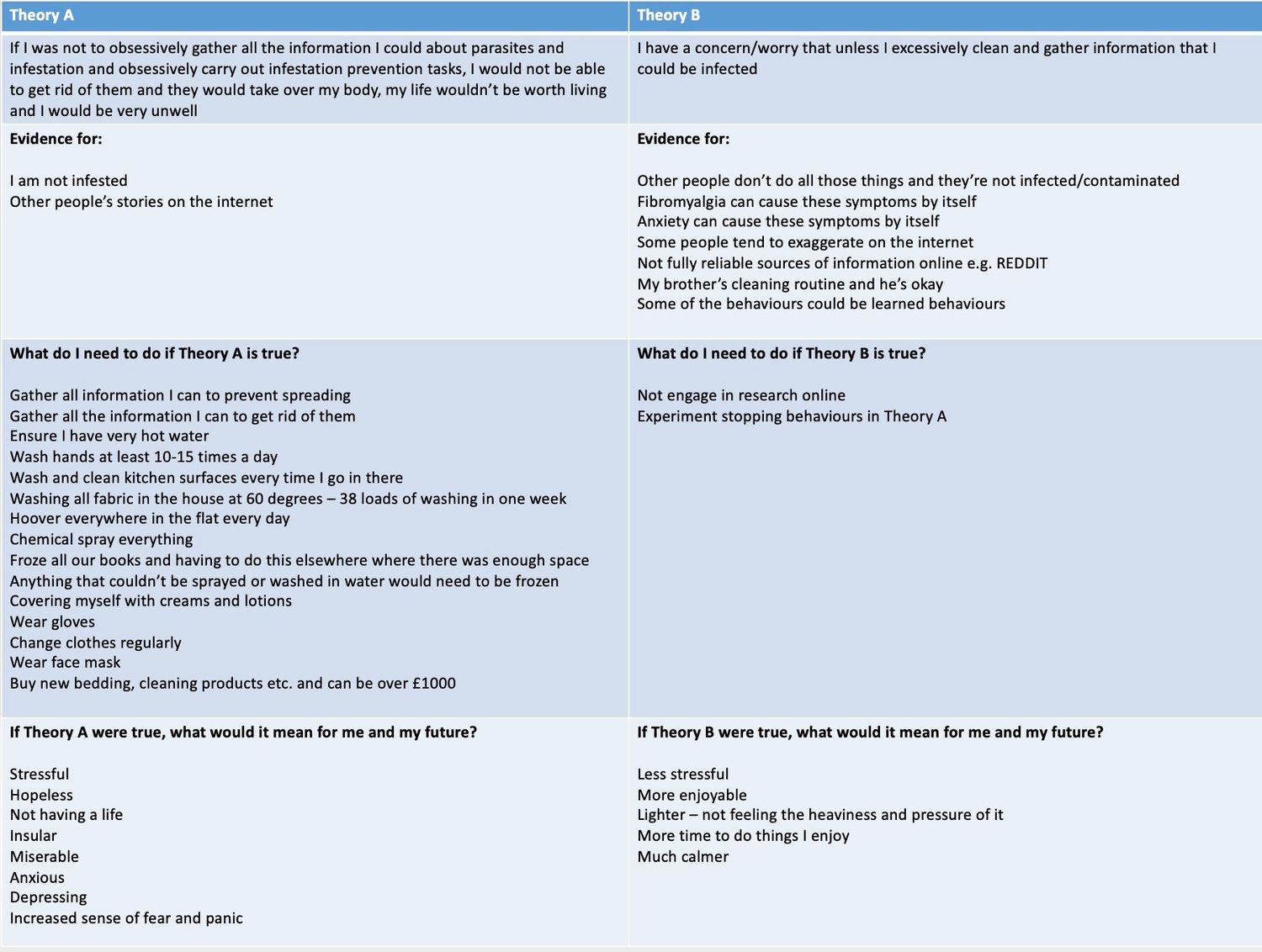
Example: Fear of parasite infestation
Theory A vs Theory B
Anxiety often rests on a hidden assumption about what the real problem is. This worksheet helps you put two competing theories side by side — and discover which one the evidence actually supports.
🔬
Two Explanations
Theory A and Theory B offer competing accounts of the same experience. Only one can be right — or at least, one fits the evidence better.
⚖️
Weigh the Evidence
What actually supports each theory? Looking at real evidence helps you move beyond gut feelings and anxious assumptions.
🎯
Consider the Implications
If each theory were true, what would you need to do? The answer often reveals which theory is keeping your anxiety going.
🔮
Look to the Future
Which theory, if true, would open up a better life? Seeing the future implications can be powerfully motivating.
How It Works
A step-by-step guide
Work through each section for both theories before moving to the next. Try to be as honest and specific as you can.
1
Understand the two theories
Theory A is usually the anxiety-maintaining belief — it frames the problem as an external threat or a real danger that must be managed. Theory B reframes the problem: the anxiety itself is the issue, not the feared thing. Theory B opens the door to different, more helpful responses.
2
State both theories clearly
Write each theory as a simple statement. Theory A often begins "My problem is that there is real danger/illness/risk..." Theory B often begins "My problem is that I am anxious about..."
3
Gather evidence for each
Write down any evidence that supports each theory. Try to be specific and honest — the evidence column often reveals that Theory B is better supported than it first appears.
4
Consider what each theory requires
If Theory A were true, what would you need to do? If Theory B were true, what then? The actions each theory demands can reveal a lot about which one is actually driving your behaviour.
5
Reflect on the future
What would each theory mean for you and your future if it turned out to be true? This question helps you see the long-term consequences of living by each theory.
Theory A — Example
"My problem is that I have a serious undetected illness. My anxiety is a reasonable response to a genuine health risk, and I need to keep checking to stay safe."
Theory B — Example
"My problem is that I am highly anxious about my health. My body's normal sensations are being misinterpreted as dangerous. The anxiety — not the illness — is what I need to address."
💡 Tip: Theory B is not about dismissing your concerns — it's about asking whether there might be a more accurate explanation for what you're experiencing. Working with your therapist on this exercise gives it extra power.
Your Worksheet
Theory A vs Theory B
Fill in both columns as fully as you can. When you're done, click the button at the bottom to receive your completed worksheet by email.
📝 Before you begin
Theory A is the anxiety-maintaining view: it treats the feared thing as the real problem (e.g., "There is actual danger / I am genuinely ill / Something really will go wrong").
Theory B is the alternative: it treats the anxiety response itself as the problem (e.g., "My problem is that I experience intense anxiety, and this anxiety — not the feared thing — is what needs to be addressed").
← Scroll left and right to see both columns →
Theory A
Theory B
State Theory A:
State Theory B:
Evidence for Theory A:
Evidence for Theory B:
What do I need to do if Theory A is true?
What do I need to do if Theory B is true?
If Theory A were true, what would it mean for me and my future?
If Theory B were true, what would it mean for me and my future?
🌿 Remember
You don't have to believe Theory B fully right now — just be willing to consider it as a possibility and act as if it might be true. The evidence will build over time as you test it out. Discuss your conclusions with your therapist if you're working with one.
Get your worksheet
Enter your email address and we'll send your completed worksheet as a PDF.