Your Cart
Loading
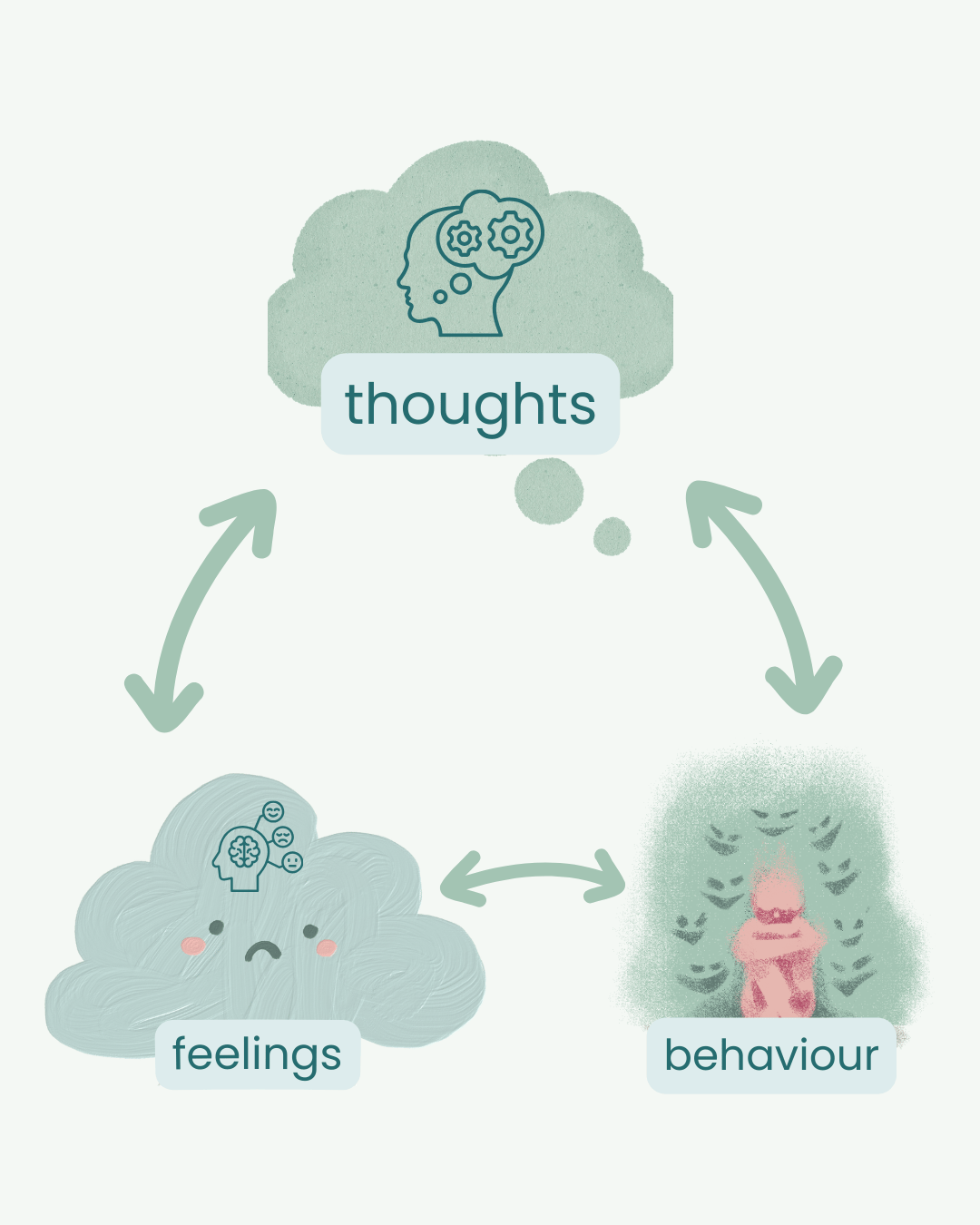
Diagram of the CBT cognitive triangle linking thoughts, feelings, and behaviours

How The Triangle Works

How Your Thoughts, Feelings, and Behaviours Are Connected — and Why Changing One Changes Everything

Picture three points of a triangle:

Thoughts → Feelings → Behaviours

Each point connects to the other two. A change at any point ripples through the entire system.

Thoughts are the interpretations, judgements, and meanings your mind assigns to events. They include automatic thoughts (the rapid, involuntary ones), assumptions, and deeper core beliefs.

Feelings are the emotions and physical sensations you experience — anxiety, sadness, anger, joy, tension in your chest, a knot in your stomach.

Behaviours are the actions you take (or avoid taking) — withdrawing from people, checking your phone compulsively, snapping at a partner, going for a run, avoiding a difficult conversation.

The crucial point: none of these exists in a vacuum. They form a cycle, and that cycle can spiral downward or upward depending on where it starts and how it's maintained.

Seeing It in Action

Let's walk through three different scenarios to see how the same triangle plays out across different emotional experiences.


Example 1: Anxiety

Situation: Your manager sends you an email saying "Can we have a chat tomorrow?"

  • Thought: "I've done something wrong. I'm going to be in trouble."
  • Feeling: Anxiety, dread, tight chest, racing heart.
  • Behaviour: You spend the evening mentally replaying everything you've done this week, lose sleep, arrive at work the next day already stressed and defensive.

Notice how the thought ("I'm in trouble") created the feeling (anxiety), which drove the behaviour (ruminating, poor sleep, defensiveness). And the behaviour reinforced the thought — because now you're tired and on edge, which makes everything feel more threatening.

What actually happened the next day? Your manager wanted to discuss a new project they thought you'd be good for.

Example 2: Depression

Situation: A friend invites you to a weekend gathering.


  • Thought: "I'll just bring everyone down. They don't really want me there. It'll be exhausting."
  • Feeling: Sadness, heaviness, guilt, fatigue.
  • Behaviour: You decline the invitation and stay home alone.

The behaviour (staying home) removes the opportunity to have a positive experience, which reinforces the thought ("Nobody wants me there" now goes unchallenged) and deepens the feeling (loneliness adds to the sadness).

Example 3: Anger

Situation: Your partner leaves dirty dishes in the sink for the third time this week.

  • Thought: "They have no respect for me. I always have to do everything."
  • Feeling: Anger, resentment, tension in the jaw and shoulders.
  • Behaviour: You snap at them, give them the silent treatment, or passive-aggressively clean up while making as much noise as possible.

The behaviour (snapping or withdrawing) creates conflict, which your partner responds to defensively, which reinforces your thought that they don't respect you. The cycle continues.

The Downward Spiral vs. The Upward Spiral

The Cognitive Triangle doesn't just create single loops — it creates spirals. Each time the cycle completes, it can either intensify or ease the difficulty.


A Downward Spiral

  1. Thought: "I'm failing at everything."
  2. Feeling: Hopelessness, fatigue.
  3. Behaviour: Stop trying. Cancel plans. Stay in bed.
  4. New thought: "See? I can't even get up. I'm pathetic."
  5. Deeper feeling: Shame, despair.
  6. Further behaviour: Withdraw completely. Stop answering messages.
  7. Even deeper thought: "Nobody cares anyway."

Each loop feeds the next. The spiral tightens and accelerates. This is how depression and anxiety maintain themselves — not through any one thought or event, but through the relentless cycling of the triangle.


An Upward Spiral

  1. Thought: "I feel awful, but maybe a short walk would help."
  2. Feeling: Still low, but a flicker of hope.
  3. Behaviour: Walk for 10 minutes.
  4. New thought: "That wasn't as hard as I expected. The fresh air helped."
  5. Improved feeling: Slightly lighter, more present.
  6. Further behaviour: Reply to a friend's message.
  7. Better thought: "Maybe I can manage more than I think."

Same triangle. Opposite direction. The upward spiral doesn't require a dramatic change — it just requires one small shift at any point.

Practical Tools: Working with the Triangle


Tool 1: The Three-Column Record

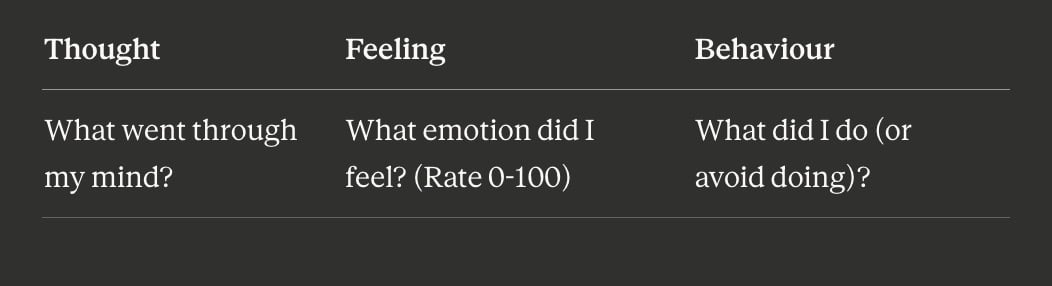
This is the simplest CBT exercise and a perfect starting point. When you notice a mood shift, write down three things, as shown in the example to the right. Just writing these down begins the process of separating thoughts from facts. You're stepping outside the triangle and observing it, rather than being trapped inside it.


Tool 2: Identify Your Entry Point

Ask yourself: which point of the triangle is most accessible to me right now?

  • If you're calm enough to think clearly → work on the thought (use a thought record).
  • If your emotions are too intense for clear thinking → work on the feeling (try breathing or grounding).
  • If you're stuck in inaction or avoidance → work on the behaviour (take one small action).

There's no wrong entry point. The best one is whichever feels most within reach in that moment.

Tool 3: Map Your Personal Patterns

Over a week, complete several three-column records. You'll start to see recurring patterns — the same types of thoughts, feelings, and behaviours appearing across different situations.

Common patterns include:

  • The anxious loop: Threat thought → anxiety → avoidance → thought confirmed
  • The depressive loop: Hopeless thought → low mood → withdrawal → thought reinforced
  • The anger loop: Unfairness thought → anger → aggressive behaviour → conflict → thought validated
  • The self-esteem loop: Self-critical thought → shame → hiding/people-pleasing → thought deepened

Recognising your pattern is powerful because it moves you from "this is just how I am" to "this is a cycle I can interrupt."

Tool 4: The Opposite Action Experiment

When you've identified your triangle, deliberately do the opposite of what the cycle is pushing you toward:

  • If the cycle says withdraw → reach out to someone.
  • If the cycle says avoid → approach the feared situation (gently).
  • If the cycle says attack → pause and respond calmly.
  • If the cycle says give up → take one small step forward.

This isn't about forcing positivity. It's about breaking the automatic chain that keeps the triangle spinning in the same direction.

A Common Misconception

People sometimes misunderstand the Cognitive Triangle as meaning "just think positively and you'll feel better." That's not what CBT teaches.


The goal isn't positive thinking — it's accurate thinking. Sometimes a negative thought is perfectly valid. If you genuinely made a mistake at work, the thought "I made a mistake" is accurate and appropriate.


What the triangle helps with is the distorted thinking — the leap from "I made a mistake" to "I'm incompetent and everyone knows it." It's the difference between a proportionate response and a spiral.

Key Takeaway

Your thoughts, feelings, and behaviours form a continuous loop. When that loop spirals downward, it can feel like reality — like you genuinely are hopeless, or the world genuinely is threatening, or you genuinely can't cope.


But it's not reality. It's a cycle. And cycles can be interrupted at any point.


You don't need to overhaul your entire way of thinking. You just need to find one point of the triangle where you can make one small change. The rest will follow.