
Your Cart
Loading

One Belief at a Time


About this worksheet

This exercise was created by Byron Katie. It is one of many self-inquiry methods that appear in her book, The Work.


If you haven't done so already, please first complete Part 1 of this exercise: Judge Your Neighbour, and email the completed worksheet to yourself.


Now that you have your completed Judge Your Neighbour worksheet, you are going to refer to the statements you wrote there for the following exercise.


Run each of the six statements in your Judge Your Neighbour worksheet (your responses to questions 1-6) through the 4-question worksheet on this page one at a time. After completing each one, click on the button at the bottom to email your responses to yourself.


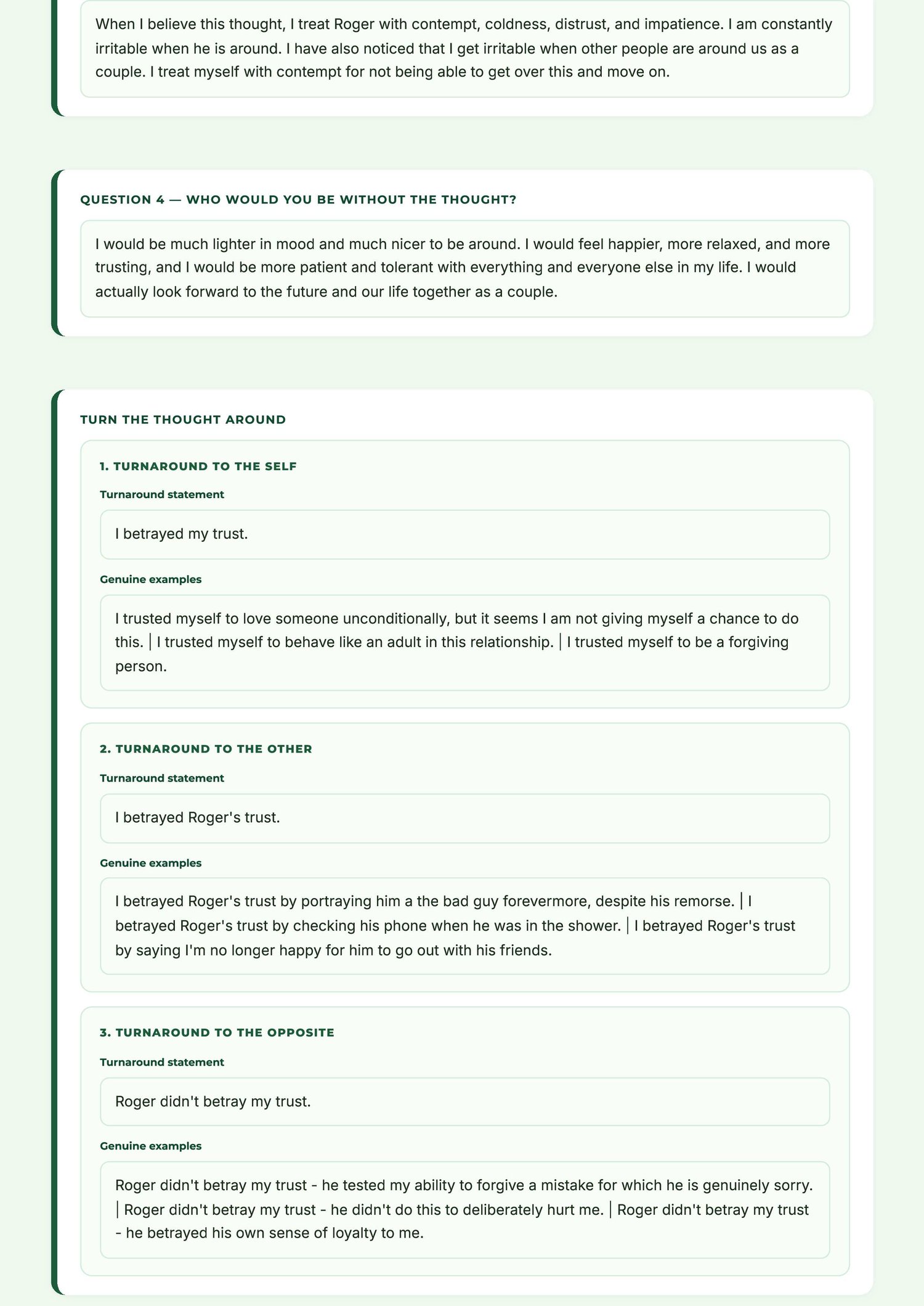
To the right, there is an an example showing how the answer to Question 1 of the Judge Your Neighbour example might be taken through the four questions in One Belief at a Time.
Leave out any statement beginning with "but", because", or "and." Often you will have several judgements about one person. Take each judgment separately through the inquiry process.


This is a form of 'meditation' inquiry. It's about awareness: it's not about trying to change your mind. Let the mind ask the questions, then contemplate. Take your time, go inside, and wait for the deeper answers to surface.


What next?

Once you have finished this exercise, you should have 7 completed PDF worksheets for this one situation. If you like, you can print them off and staple them together.


Alternatively, you can download them and file them together in a folder on your computer. You may want to refer back to them when you encounter similar situations in the future.

One Belief at a Time | ChatCBT

The Work — A Written Meditation

One Belief at a Time

Stressful thoughts only have power when we believe them unquestioningly. Byron Katie's four questions help you hold a thought up to the light — and discover what's really true.

🎯

One Belief

Focus on a single stressful thought about someone and give it your full attention.

❓

Four Questions

Is it true? Can you absolutely know it's true? How do you react? Who would you be without it?

🔄

The Turnaround

Find the opposite perspectives — and discover that they may be just as true, or truer.

🕊️

Find Peace

Inquiry doesn't change the past — it changes your relationship with your thoughts about it.

A step-by-step guide

Work slowly and honestly through each question. Close your eyes where you can. Inquiry stops working the moment you stop answering the questions.

1

Write down the belief

Choose a stressful thought about someone you haven't fully forgiven. Write it as a simple statement, for example: "He doesn't care about me."

2

Is it true? Can you absolutely know it's true?

Answer yes or no only. Don't explain — just drop into your body and find your honest answer. If you answer "No" to Question 1, skip straight to Question 3.

3

Explore your reaction

How do you react — what happens — when you believe the thought? Work through each sub-question slowly. Notice images, emotions, sensations, and behaviours.

4

Who would you be without the thought?

Close your eyes. Imagine yourself in the same situation, with the same person — but without the ability to think that thought. Who would you be? How would you feel, how would you act if you simply could not think that thought? What would your life look like without that thought?

5

Turn the thought around

Find three genuine turnarounds of your original statement — to the self, to the other, and to the opposite. For each one, find at least three specific, real examples of how the turnaround is true.

💡 Tip: Be still as you answer. Don't rush. The most powerful answers come not from your thinking mind, but from what arises when you genuinely look.

One Belief at a Time

Fill in each section. When you're done, click the button at the bottom to receive your completed worksheet by email.

📝 Before you begin

Write down a stressful thought about someone — alive or dead — whom you haven't forgiven 100 percent. For example: "He doesn't care about me." Then work through the questions below. Close your eyes, be still, and witness what appears to you. Inquiry stops working the moment you stop answering the questions.

The Belief

Write your stressful thought or belief about the other person as simply as you can.

▼

Question 1 — Is it true?

Yes or no only. Don't explain or justify — just find your honest answer. If you answer No, skip to Question 3.

▼

Question 2 — Can you absolutely know that it's true?

Not "probably" or "mostly" — can you know it with 100% certainty? Yes or no.

▼

Question 3 — How do you react, what happens, when you believe that thought?

Close your eyes and sit with the thought. Work through each question below, witnessing what arises.

For example: alcohol, food, work, social media, exercise, shopping, television, withdrawal from others...

▼

Question 4 — Who would you be without the thought?

▼

Turn the Thought Around

Take your original belief and find three turnarounds. For each one, find at least three specific, genuine examples of how the turnaround is true for you in this situation. Let yourself fully experience the turnarounds. This is not about blaming yourself or feeling guilty. It's about discovering alternatives that can bring you peace.

Example Original statement: "He hurt me."
Turnaround to the self: "I hurt me."  |  Turnaround to the other: "I hurt him."  |  Turnaround to the opposite: "He didn't hurt me."
1. Turnaround to the self
Turn the original statement so that it refers to you instead. e.g. "He doesn't care about me" → "I don't care about me."
Your turnaround statement
At least three genuine examples of how this is true
2. Turnaround to the other
Turn the statement so that you are doing to them what you said they did to you. e.g. "He doesn't care about me" → "I don't care about him."
Your turnaround statement
At least three genuine examples of how this is true
3. Turnaround to the opposite
Turn the statement to its complete opposite. e.g. "He doesn't care about me" → "He does care about me."
Your turnaround statement
At least three genuine examples of how this is true

🕊️ Closing reflection

The turnarounds are about welcoming all your thoughts and experiences with open arms, as it shows you where you are still at war with reality. If you feel any resistance to a thought, your Work is not done. When you can honestly look forward to experiences that have been uncomfortable, there is no longer anything to fear in life: you see everything as a gift that can bring you self-realisation.

Inquiry is not about positive thinking or forcing yourself to feel better. It's about discovering what's genuinely true when you look closely. Even one turnaround that lands as real can begin to shift years of pain. Be patient and kind with yourself throughout this process.

Based on The Work by Byron Katie · © Byron Katie International, Inc. All rights reserved · thework.com