


Unhelpful Thoughts
We know our thoughts affect how we feel. Positive thoughts often lead to positive feelings, while negative thoughts can lead to anxiety, sadness, or low motivation.
These are sometimes called ‘unhelpful’ thoughts because they contribute to unpleasant emotions or behaviours. Everyone has them from time to time, but if they happen often and cause distress, it helps to take a closer look at your thinking.
Changing unhelpful thoughts can lead to more helpful emotions and behaviours. The first step is becoming aware of these thoughts so you can begin to challenge and balance them.
One useful tool for this is the ABC model, which shows how our emotions and actions come from our thoughts.
A – Activating event/situation Something that happens externally or internally (e.g. an event, memory, or thought).
B – Beliefs and thoughts These include automatic thoughts, self-talk, and underlying beliefs (e.g. "I'm a failure" or "I can't do this").
C – Consequences The feelings, behaviours, and physical responses that follow (e.g. anxiety, low mood, avoidance).

Negative Thinking and Depression
What do we know about thoughts?
We normally assume that if something good happens, we feel happy and if something bad happens, we feel unhappy. However, if this were true, we would all have the same reaction to the same event, which is clearly not the case.
Here is an example of how two individuals might respond to the same event.
Person A
Something happens
A friend you've arranged to meet for lunch doesn't turn up.
We think about it / interpret it
She doesn't like me. Everyone here thinks I'm a loser.
We experience emotions and body sensations as a result
Upset. Sinking feeling in stomach.
We behave in accordance with our thoughts and feelings
Leave the restaurant and avoid looking at anyone.
Person B
Something happens
A friend you've arranged to meet for lunch doesn't turn up.
We think about it / interpret it
I expect she got held up at work. Great, I can finish my book while I wait.
We experience emotions and body sensations as a result
Happy. Relaxed and calm.
We behave in accordance with our thoughts and feelings
Order a coffee, sit back and read a book.

When you are depressed, your thoughts about yourself, your life and the future may all contain negative biases which distort your thinking and make you feel worse. These thoughts often encourage you to attend only to negative details that confirm your conclusions and ignore anything else.
Thought control?
As our thoughts are so important, it might seem like a good idea to try to control our thoughts. However, in practice this is not a successful strategy.
For example, if someone tells you not to think about white rabbits, what is the most likely first thought to jump into your head? (Spoiler: it’s white rabbits!).
We cannot stop thoughts, but once we notice them, we have choices about what we do with them. The aim in CBT is to reduce the effects of negative thoughts on how you feel. The first step is to recognise your thoughts.

What are negative automatic irrational thoughts (NAITs)?
Negative: they make you feel worse about yourself (e.g. I'm useless) and your life (e.g. it's all hopeless). They also stop you from helping yourself (e.g. there's no point).
Automatic: they just pop into your head, you don't decide to think them.
Irrational yet believable: they seem to be right and utterly true. They feel like they are facts and you will tend to accept them as truth. However, these thoughts are often irrational and have no basis in truth. Although they seem right, they are likely to be distorted or inaccurate.
Uncovering your NAITs and understanding how they trigger depressed mood
It is important to become aware of negative thinking and how this affects mood. A good way to help identify NATs is to fill out a thought record.
Here are some other ways to recognise your NAITs:

1. Notice when your mood drops
The best way to become aware of your NATs is to write them down and it is best to do this as soon as possible after you notice your mood changing.
Write down:
- the date/the situation you were in just before your mood dropped
- the emotions you were feeling.
Then rate each emotion on a scale of 0-100 so that you'll be able to remember how strongly you felt and what was going through your mind (thoughts and images). You might find it helpful to write these details in a table with three columns, labelled:
1. Situation
2. Emotions
3. Automatic thoughts
For example:
Situation: Waiting for my friend in a restaurant
Emotion: Sad - 100%
Automatic thought: She forgot about me (mind reading)
Emotion: Lonely - 90%
Automatic thought: She doesn't like me (mind reading)
Emotion: Hopeless - 70%
Automatic thought: No one likes me (over generalisation)
It may help to answer some of the following questions:
- What was going through my mind just before I started to feel this way?
- What does this say about me?
- What does this mean about my life? My future?
- What am I afraid might happen?
- What is the worst thing that could happen if this were true?
- What does that mean about how the other person fees/thinks about me?
- What does that mean about the other person or people in general?

2. Recognise your unhelpful thinking patterns
It is very useful to learn to recognise unhelpful, distorted thinking patterns. When you look at your NAITs, you might notice similar kinds of thoughts repeating themselves.
Unhelpful Thought Patterns
All or Nothing Things are either one way or the other...no middle ground. For example, if you make one small mistake the whole thing is a failure.
Over generalising Applying the experience of one situation to 'all the time' - use of words such as ‘always’ and ‘never’. For example, not getting one particular job becomes: 'I'll never get a job'
Personalising Taking personal responsibility for something that is not your fault. For example, if your partner is in a bad mood you think: 'I must have done something wrong.'
Mind Reading / Jumping to Conclusions You think you know what people are thinking and jump to conclusions.For example, if a friend ignores you in the street, you think: 'They don't like me anymore.'
Catastrophising Everything is blown out of proportion and ends in catastrophe. For example, if a family member is late home, you think: 'They've had an accident.’
Disqualifying the Positive You focus on the negative and disregard the positive. For example, if someone compliments your outfit, you say: “What, this old thing?” instead of “Thank you.”
Shoulds / Oughts / Musts You have fixed rules and unrealistic expectations that can lead to unnecessary guilt or disappointment. For example, you might think: 'I ought to go to the gym more often;' 'I should visit my family more;' 'I must put others first.'

3. Identify the 'hot thought'
When you read through your NAITs, you may notice a thought which has a particularly strong emotional ‘charge’.
This NAIT usually links to the most distressing emotion. It is useful to highlight this so it can be checked out more thoroughly.
Challenging Unhelpful Thoughts
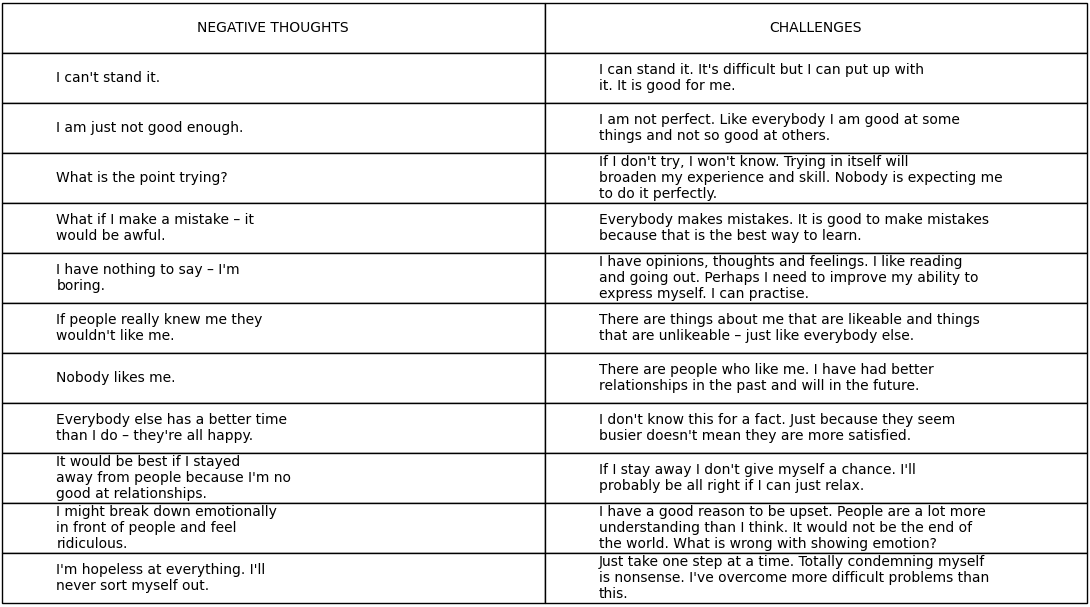
Negative Thoughts & Challenges: The Double Column Technique
Once you are aware of your unhelpful thoughts, you can begin to challenge and balance them.
Write down on a piece of paper all your negative thoughts and then challenge them. Here are some examples:
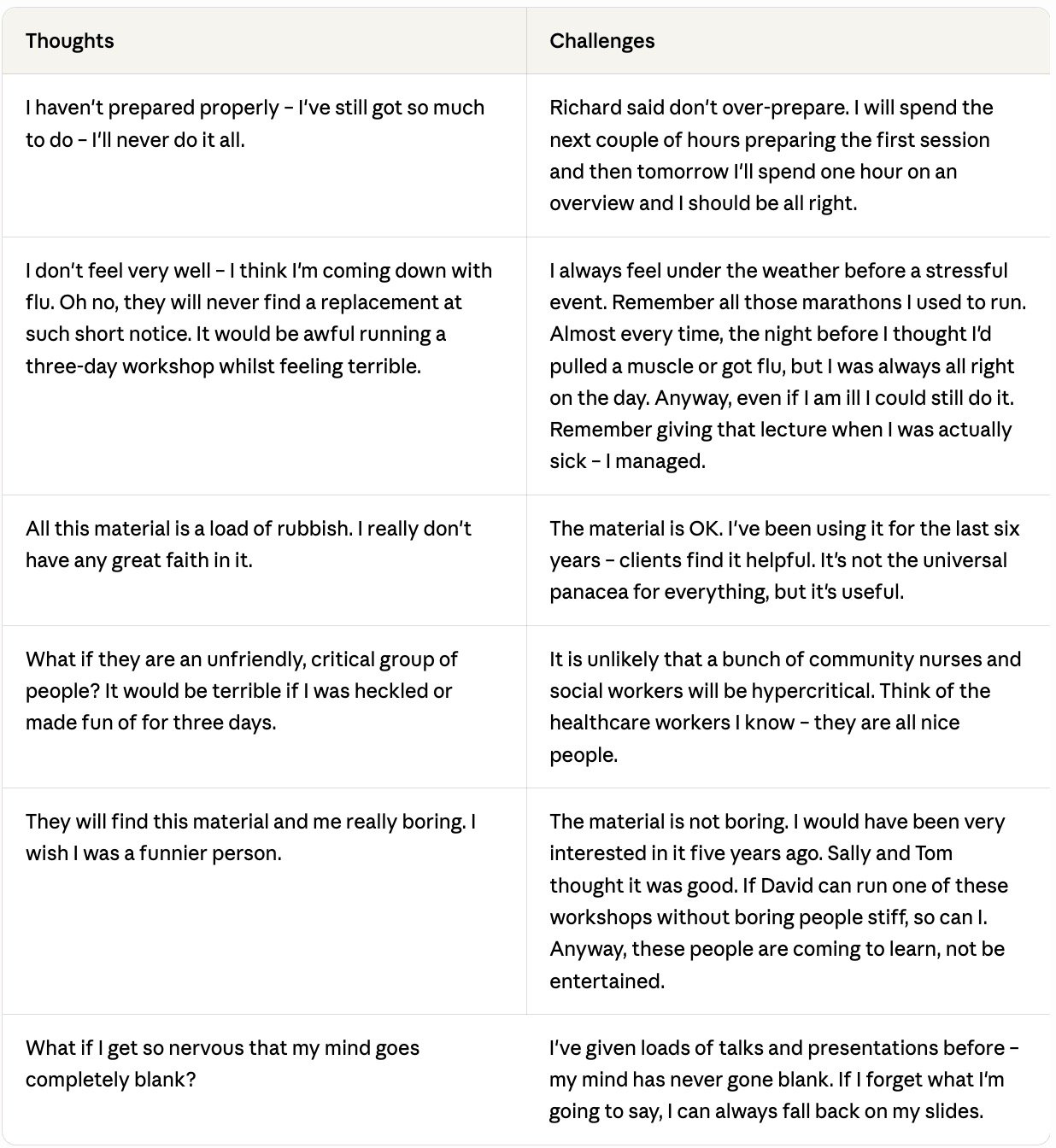
EXAMPLE
Situation
Feeling low and anxious, 24 hours before running his first three-day workshop, Robin can't quite put his finger on what is wrong. He asks himself: “What am I thinking?” Robin writes down his key thoughts and realises they are somewhat distorted.
After challenging these thoughts he feels more positive.

Key Takeaway: Wise Mind
Thinking and feeling are both essential parts of life. Some people think too much and are not aware of their feelings, while some people feel too much and are not aware of their thoughts - either extreme can be a problem.
The overlap or integration of thoughts and feelings, when things come together, could be termed 'Wise Mind' - something to work towards.
Rational Mind
Thinking, rational, logical, attention to facts, the evidence, planning, organising, problem solving. These skills are located in the frontal lobes of the brain.
Emotional Mind
Strong emotional states surge up from the primitive, emotional heart of the brain (amygdala). These emotions may be based on early fears and they can influence and distort thinking.
Wise Mind
Integration of rational and emotional. Intuition. Quiet sense of peace, knowing, centred.
If you experience unhelpful thoughts often, you may also experience intrusive thoughts, which are more distressing.