



About This Worksheet
Rules and Assumptions
Standards are the performance benchmarks you establish for yourself or others across various domains — such as career, health, appearance, or social life. While most people maintain such expectations, they often manifest in two different ways: as conscious, explicit rules or as subconscious, unspoken assumptions.
When these standards become excessively demanding, they function as inflexible "musts" or "shoulds" (for example, the belief that you must never make a mistake or that you must please everyone you meet). Relying on these rigid frameworks can create significant personal and interpersonal strain.
Fortunately, these internal guidelines are not permanent. You can adjust and refine the rules and assumptions that govern your behaviour, beginning with a conscious awareness of what they are and how they currently influence your daily life.
Benefits of The Modification Approach
- Surface Hidden Patterns: Behavioural rules are influential but often subconscious. This process helps you pinpoint specific internal mandates that may be creating obstacles.
- Evaluate Fairness: By analysing how these assumptions dictate your emotions and actions, you can objectively determine if they are actually reasonable or just.
- Increase Flexibility: Softening rigid expectations allows you to pursue your values more freely and effectively.
Implementation Steps
It is recommended to first navigate this process alongside a therapist.
- Select a Focus: Pick a specific "rule" or underlying assumption you wish to examine.
- Assess Impact: Detail the ways this standard influences your routine and overall well-being.
- Trace the Source: Reflect on where this belief originated or how it developed.
- Weight the Pros and Cons: Identify what the rule attempts to protect or achieve, versus the limitations or stress it imposes.
- Develop a Versatile Alternative: Create a more adaptable guideline that retains the core benefits of the original without the same negative side effects.
Key Considerations
- Identify the Language: Problematic rules often present as absolute demands, using words like "must," "should," or "ought."
- Check for Accuracy: Even if an assumption feels deeply true, it may not be a factual or balanced representation of reality.
- Spot the Logic: Many assumptions follow an "If... then..." structure (e.g., "If I never fail, then I will be worthy of respect").
The examples below are courtesy of Psychology Tools. Take a look at them before you complete your own worksheet.
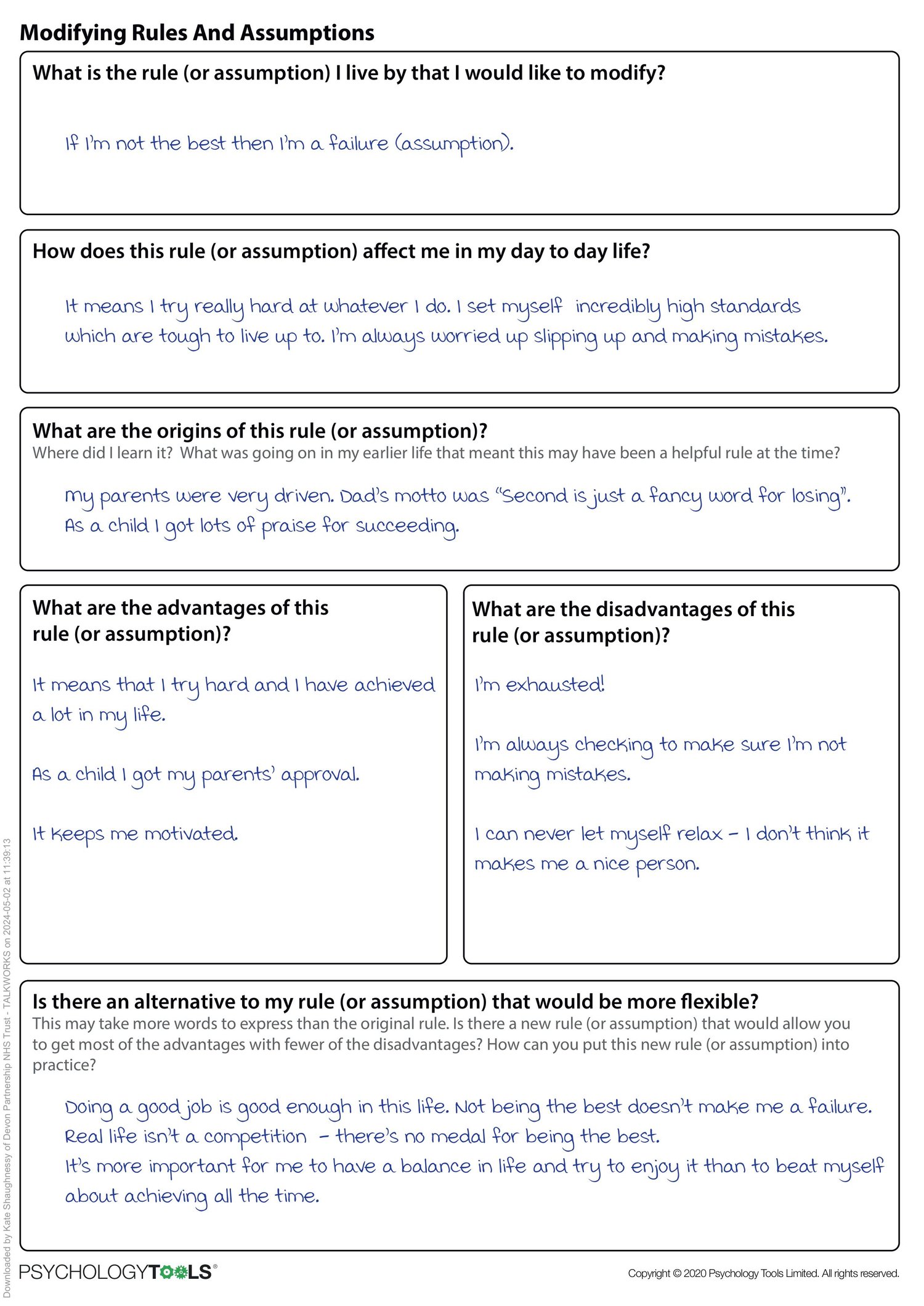
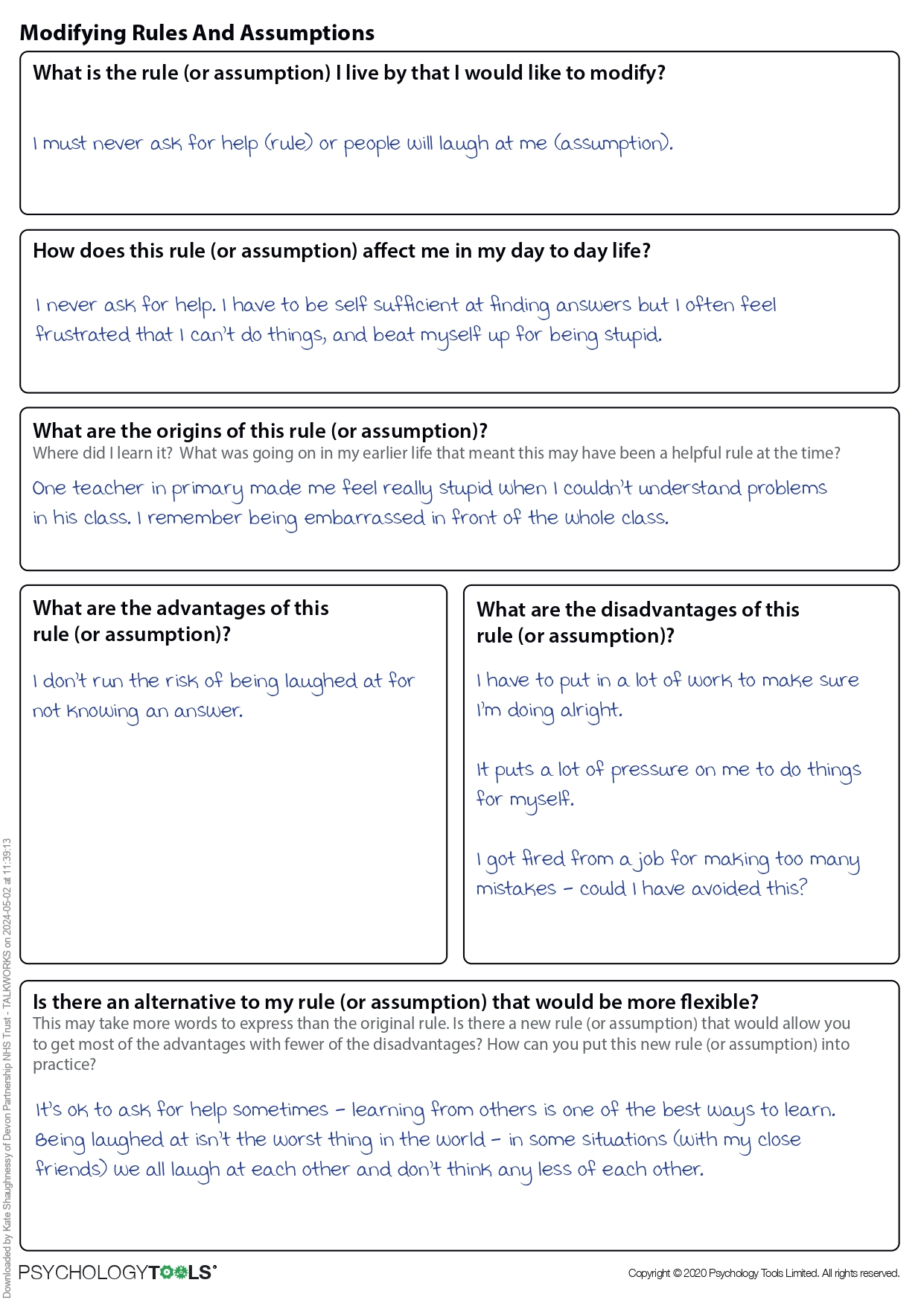
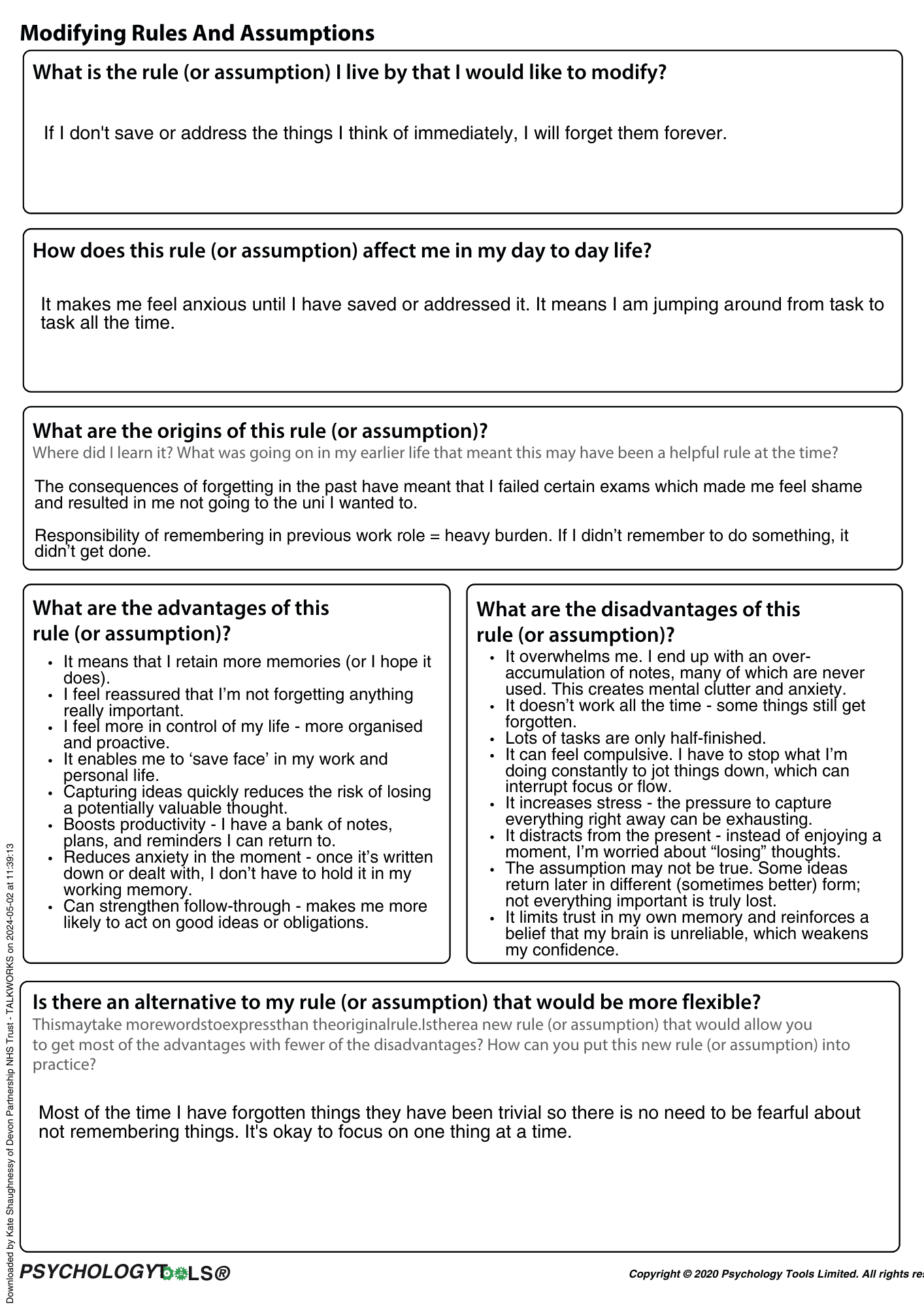
Modifying Rules & Assumptions
Unhelpful rules and assumptions quietly shape how we live. This worksheet helps you examine them honestly — and build something kinder and more flexible in their place.
🔍
Uncover the Rule
Bring your hidden "if–then" assumptions into the open where they can be examined.
⚖️
Weigh the Evidence
Look honestly at what supports and contradicts your old rule — with curiosity, not judgement.
🌱
Craft a New Rule
Replace rigid beliefs with a balanced, compassionate alternative that serves you better.
🚀
Plan the Change
Identify the small behavioural shifts that will help your new rule take root in daily life.
How It Works
A step-by-step guide
Work through each section in order. Take your time — honest reflection leads to the most useful results.
1
Identify the old rule
Write down the rule or assumption you want to work on. It often sounds like: "If I don't… then…" or "I must always…"
2
Explore its origins
Reflect on where this rule came from. What experiences, messages, or relationships helped form it?
3
Weigh up advantages & disadvantages
Consider how this rule has helped you — and how it has held you back or caused you difficulty.
4
Examine the evidence
Look for real examples that support or challenge the rule. Try to be as balanced and specific as possible.
5
Build a new rule & action plan
Write a more flexible, compassionate rule — then plan the small steps that will help you live by it.
💡 Tip: Rules and assumptions are not facts — they are learned patterns. Noticing them is the first and most important step towards changing them.
Your Worksheet
Modifying Rules & Assumptions
Fill in each section. When you're done, click the button at the bottom to receive your completed worksheet by email.
📝 Before you begin
Rules and assumptions are the "if–then" beliefs that govern how we act. For example: "If I show weakness, people will reject me" or "I must always put others first." They often developed for good reasons but can become too rigid over time.
Step 1 — Identify Your Old Rule or Assumption
Write the rule as clearly as you can. Try using "If… then…" or "I must / I should…" format.
▼
Step 2 — Where Did This Rule Come From?
Think back to when this rule might have formed. What experiences, people, or messages shaped it?
▼
Step 3 — Advantages & Disadvantages of the Old Rule
Be honest about both sides. What has this rule given you — and what has it cost you?
✅ Advantages
⚠️ Disadvantages
▼
Step 4 — Evidence For & Against the Old Rule
Look for specific examples from your life that either support or challenge this rule.
📋 Evidence that supports it
🔄 Evidence against it
▼
Step 5 — Your New, More Balanced Rule
Write a new rule that is kinder, more flexible, and more realistic. It should feel genuinely believable — not just positive.
▼
Step 6 — Advantages of Your New Rule
How might your life improve if you lived by this new rule? What would become possible?
▼
Step 7 — Behavioural Changes to Make
What will you do differently to start living by your new rule? List specific, small actions you can take.
▼
Step 8 — Possible Obstacles
What might get in the way of living by your new rule? Think about situations, feelings, or habits that could pull you back.
▼
Step 9 — How I Will Overcome These Obstacles
Plan how you will respond when you notice the old rule taking over. What will you say to yourself? Who or what can help?
🌿 Remember
Changing deeply held rules takes time and repeated practice. Every time you choose to act according to your new rule — even in a small way — you are rewiring old patterns. Be patient and compassionate with yourself throughout this process.
Get your worksheet
Enter your email address and we'll send your completed worksheet as a PDF.