



Uncertainty is an inherent part of life; absolute certainty regarding the future is impossible. While some individuals adapt easily, others find this lack of predictability highly distressing.
Psychologists describe this distress as an intolerance of uncertainty. Much like an allergy, even a minute amount of ambiguity can trigger a significant emotional or physical reaction. These anxious responses are rooted in your underlying beliefs — for instance, the idea that uncertainty is inherently 'unfair' or 'disastrous.' Such beliefs can spark negative predictions that lead to further psychological hurdles. Many people find it beneficial to systematically examine and challenge these assumptions.
Use the Behavioural Experiment worksheet on this page to test what happens when you try to manage without your usual coping mechanisms and safety behaviours in uncertain situations.
It is best to practise this exercise with your therapist before attempting it independently.
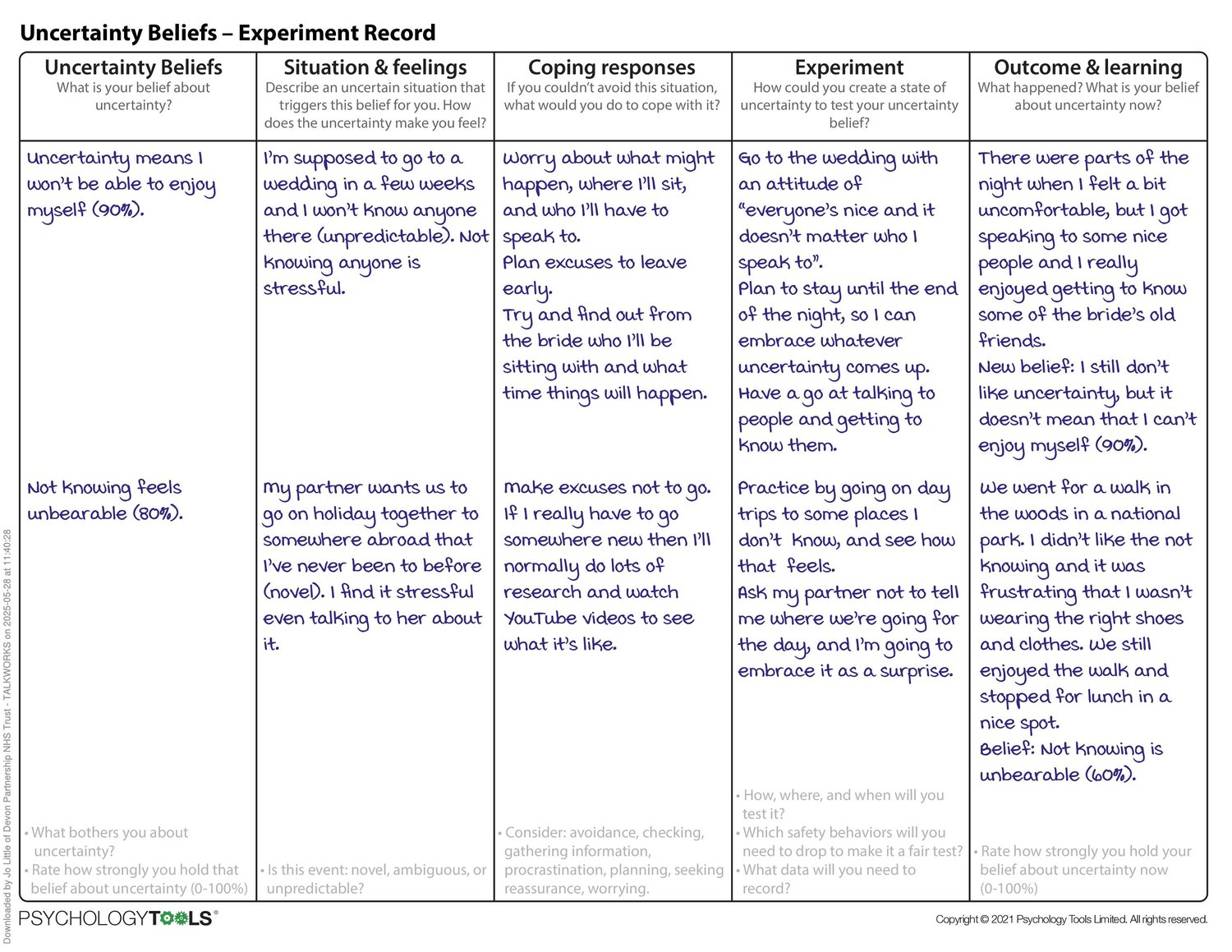
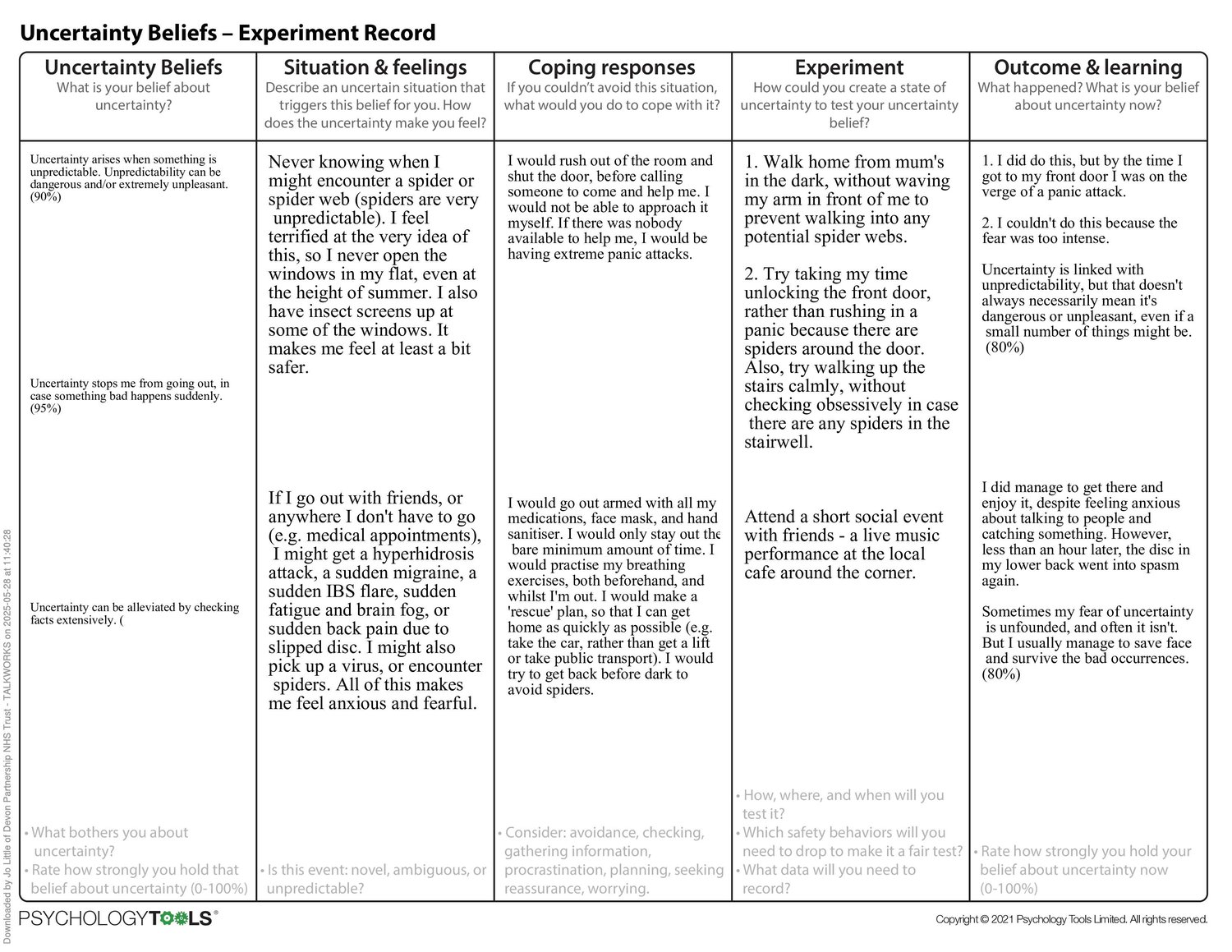
Below are a couple of examples of how these experiments might look in practice. Take a look at these before you try your own experiment.
The Behavioural Experiment worksheet template comes courtesy of Psychology Tools. The second example is my own.
Explore and test your beliefs about uncertainty — and discover that you can cope better than you think.
Identify the specific beliefs you hold about uncertainty and how strongly you hold them
Deliberately face uncertain situations to test whether your predictions actually come true
Record what actually happens versus what you predicted — and notice the difference
Use real-world evidence to develop more balanced, flexible beliefs about uncertainty
Start by describing a belief you hold about uncertainty and rating how strongly you believe it. Identify a situation that triggers this belief and note your usual coping responses. Then design a small real-world experiment to test the belief — ideally dropping safety behaviours to make it a fair test. Afterwards, record what actually happened and re-rate your belief. Add as many experiment records as you need.
Life is uncertain. Nobody can ever be 100% sure of what will happen next. Some people are comfortable with this — but others find it deeply unpleasant. Psychologists call this intolerance of uncertainty, and it can drive significant anxiety and worry. Even a small amount of uncertainty can trigger a large reaction.
The good news is that our beliefs about uncertainty are not facts — they are learned assumptions that can be examined and updated. By exploring and testing these beliefs with real experiments, we can begin to build a more flexible, balanced relationship with the unknown.
We'll email you a PDF copy of your completed worksheet.
Your answers are only used to generate your PDF.
By using this website, you agree to our use of cookies. We use cookies to provide necessary site functionality and provide you with a great experience.
Your message has been successfully sent
Your form has been submitted. Please check your email for a copy of your responses. If you're accepted, you'll receive an email with a link to checkout.