Graded Exposure
How to Face Your Fears One Step at a Time — Without Overwhelming Yourself

How to Face Your Fears One Step at a Time — Without Overwhelming Yourself
If the idea of facing your fears feels terrifying, there's a reason: your brain is picturing the worst version of it. The biggest fear. The hardest scenario. The moment of maximum discomfort. And from that perspective, exposure sounds less like therapy and more like torture.
But that's not how it works. Graded exposure is the structured, step-by-step approach to facing feared situations that starts small — really small — and builds gradually. You don't confront your biggest fear on day one. You start with something that feels mildly uncomfortable, master that, and then take the next step. And the next. Each step is manageable because the one before it has already reduced your anxiety and built your confidence.
Think of it like learning to swim. Nobody throws a nervous beginner into the ocean. You start at the shallow end. You get used to the water. You practise floating. You move a little deeper. Eventually, you're swimming in open water — not because someone forced you, but because each step prepared you for the next one. Graded exposure works the same way.
There are important reasons why the graduated approach is more effective — and more sustainable — than simply throwing yourself at your biggest fear.
Anxiety exists on a spectrum. At low levels, it's barely noticeable. At moderate levels, it's uncomfortable but manageable. At extreme levels, it's overwhelming — and when you're overwhelmed, your brain stops learning and switches entirely into survival mode.
For exposure to produce lasting change, you need to be in what psychologists call the "learning zone" — anxious enough that the experience is meaningful, but not so anxious that your brain shuts down. Graded exposure is specifically designed to keep you in this zone at every step.
If you jump straight to the most feared scenario and the experience is too intense, there's a risk of sensitisation — where the fear actually increases rather than decreases. Instead of learning "This isn't as dangerous as I thought," your brain learns "This was every bit as terrible as I feared, and now I know to avoid it even more." Gradual exposure avoids this by ensuring that each experience is challenging but not traumatic.
Each step you complete successfully becomes evidence. Evidence that you can face discomfort. Evidence that anxiety peaks and then falls. Evidence that the catastrophic outcome doesn't materialise. By the time you reach the higher steps on your hierarchy, you're carrying a substantial body of evidence from all the steps below — and that evidence makes the harder steps feel more achievable.
Success breeds success. Completing a low-anxiety step gives you a small boost of confidence and motivation. That confidence makes the next step feel more approachable. Each step forward creates psychological momentum that carries you toward the next one. This is far more sustainable than a single, dramatic confrontation that leaves you exhausted and shaken.

The hierarchy is your roadmap — a personalised ladder of situations, ranked from least to most anxiety-provoking. Building it well is the most important part of the process, because a good hierarchy makes everything that follows easier.
Be specific about what you're afraid of. "Social situations" is too broad. "Being the centre of attention in a group of people I don't know well" is specific enough to work with. "Dogs" is a start, but "Being in close proximity to a large, unleashed dog" is more precise and gives you more options for graduated steps.
The clearer you are about the specific fear, the easier it is to design steps that approach it incrementally.

Write down every situation you can think of that triggers this fear, without worrying about order. Include things you currently avoid, things you endure with significant anxiety, and things you've stopped doing because of the fear. Think about different contexts, different severity levels, and different variations.
For someone with a fear of public speaking, this might include: answering a question in a small meeting, making a toast at a family dinner, presenting slides to their team, speaking at a conference, being asked an unexpected question in front of a group, recording a video of themselves speaking, speaking without notes, and so on.
Go through your list and rate each situation for the anxiety it would cause, using a 0-to-100 scale where 0 is completely calm and 100 is the most intense anxiety you can imagine.
Don't overthink the ratings — your first instinct is usually accurate enough. And don't worry if some situations have similar ratings. You'll refine the order in the next step.

Put the situations in order from lowest anxiety to highest. This is your hierarchy. Aim for 8 to 15 steps, with relatively even gaps between them. If there's a big jump (say, from 35 to 70), look for an intermediate situation to bridge the gap. If two situations have very similar ratings, you might combine them or choose the one that's more practically accessible.
Step 5: Check for Completeness
Review your hierarchy and ask: Does the first step feel genuinely manageable — something I could do this week, even if it's slightly uncomfortable? Does the final step represent the situation I most want to be able to face? Are the gaps between steps small enough that each feels like a natural progression from the last?
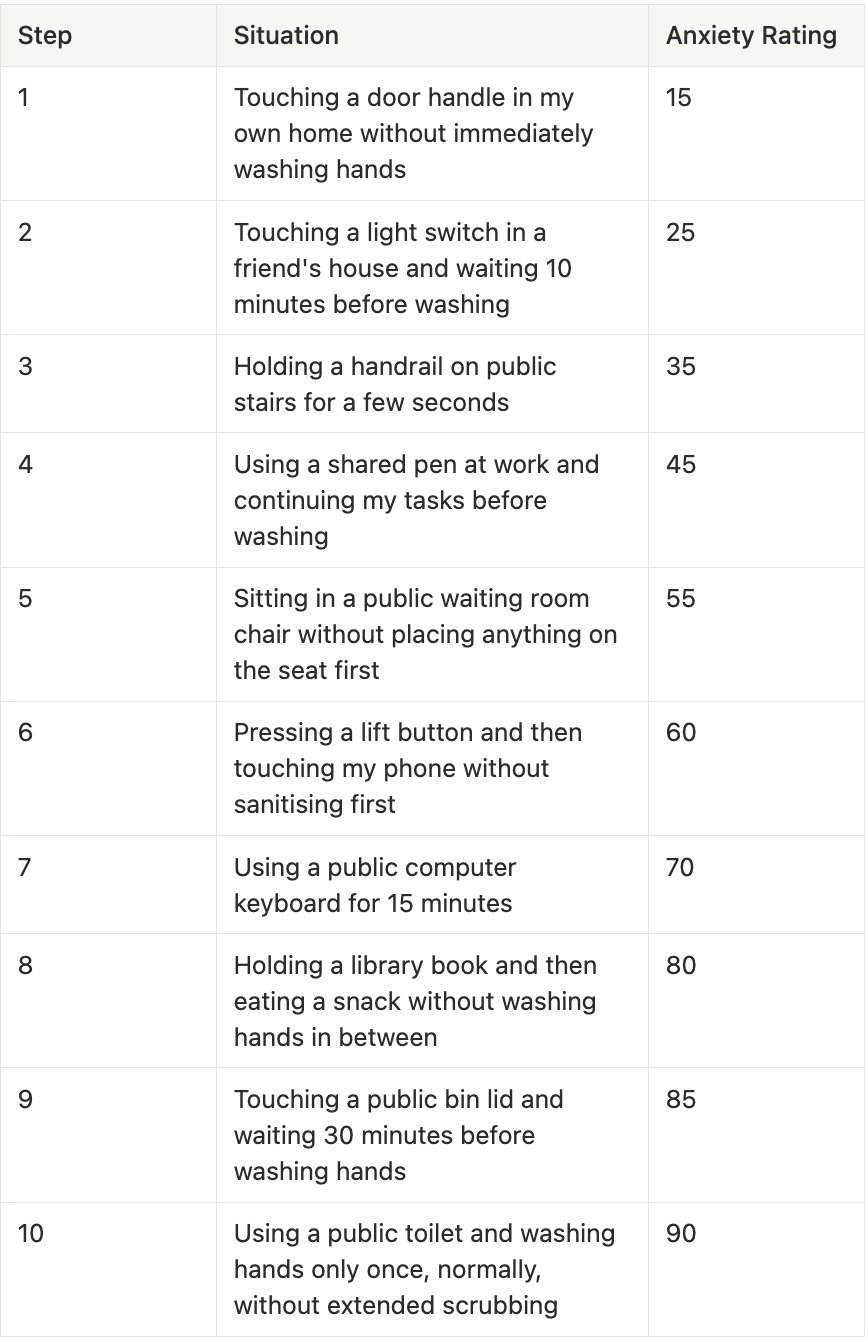
Here's a complete hierarchy for someone who avoids touching public surfaces due to contamination fears, showing how the steps build gradually.
Notice how each step introduces a slightly greater challenge. The person isn't asked to go from zero to touching a bin lid. They build tolerance gradually, with each step reinforcing the learning from the one before.

You don't need a diagnosable phobia to benefit from graded exposure. Many people have patterns of avoidance that aren't clinical but still limit their lives: avoiding difficult conversations, putting off phone calls, declining social invitations, procrastinating on tasks that feel overwhelming.
The same principles apply. Identify what you're avoiding. Rate the anxiety associated with different versions of the avoided situation. Start with the easiest version. Build up gradually.
For example, if you avoid difficult conversations:
Each step builds the evidence that speaking up doesn't lead to catastrophe — and that you can handle the discomfort even when the conversation is imperfect.
Graded exposure is a powerful self-help tool, but some situations benefit from professional guidance. If your fear is related to trauma, if your anxiety is so severe that even the lowest step feels unmanageable, if you've been trying self-guided exposure for several weeks without progress, or if the fear is significantly impairing your daily functioning, a CBT therapist can help you design a more tailored hierarchy, support you through the harder steps, and troubleshoot any obstacles that arise.
There's no shame in getting professional help — in fact, it's one of the most effective things you can do. Exposure therapy, guided by a skilled therapist, has some of the highest success rates of any psychological treatment.

Graded exposure makes the daunting task of facing your fears feel achievable by breaking it into manageable steps.
Starting small isn't a sign of weakness — it's the strategy that produces the most reliable, lasting results. Each step you complete teaches your brain something new, builds your confidence, and prepares you for the next challenge.
The fear doesn't disappear in one dramatic moment. It fades gradually, step by step, as you accumulate evidence that you are braver, more resilient, and more capable than your anxiety has led you to believe.