



About This Worksheet
Testing Beliefs Through Action
Lucy held the core belief that she was dull, assuming others would find her uninteresting. Because socialising caused her anxiety, she frequently used a 'safety behaviour': asking others constant questions to hide her own perceived lack of personality.
We all maintain internal beliefs about ourselves and the world. However, if these beliefs are inaccurate, they can negatively dictate our thoughts, emotions, and actions. Lucy’s therapist challenged her to consider: "What would happen if I stopped asking so many questions?" To find the answer, Lucy realised she had to test her assumption in the real world.
The Scientist’s Approach
A helpful way to view this is by mimicking how scientists work. They treat their beliefs as 'hypotheses' — educated guesses rather than established facts — and remain open to new evidence. They then design experiments to see if those guesses hold up under scrutiny.
How This Tool Supports You
The Behavioural Experiment worksheet is designed to help you:
- Collect fresh, objective data.
- Scrutinise the validity of your beliefs and predictions.
- Experiment with new ways of acting or abandon habits that restrict your progress.
How to Use the Worksheet
Complete the first two sections while planning your test, and the final two sections once the experiment is finished.
- Prediction: State the specific assumption you want to test and define what 'failure' would look like. Rate your belief in this outcome from 0–100%.
- Example: Lucy predicted that talking about herself would cause others to become bored. She decided she would know this had happened if people yawned or walked away while she was speaking.
- Experiment: Outline a clear plan to test your belief.
- Example: Lucy planned to talk about herself with at least five different people at a party while observing their reactions for signs of boredom.
- Outcome and Learning: Carry out the plan and record the results. Re-rate your belief in the original prediction (0–100%) based on what you discovered.
- Example: After speaking to six people, Lucy noted that no one yawned or left abruptly. She concluded, "I can be interesting sometimes," though she felt she needed more evidence to believe it fully.
- What’s Next? Consider further tests or other beliefs to investigate.
- Example: To ensure her success wasn't just a 'fluke', Lucy decided to repeat the experiment in different social settings.
Behavioural Experiments can be adapted and modified to fit specific use cases. For example, two extra columns — Uncertainty Beliefs and Coping Responses — can be added for someone who has difficulty coping with uncertainty. You can see a couple of examples of how this looks in practice here.
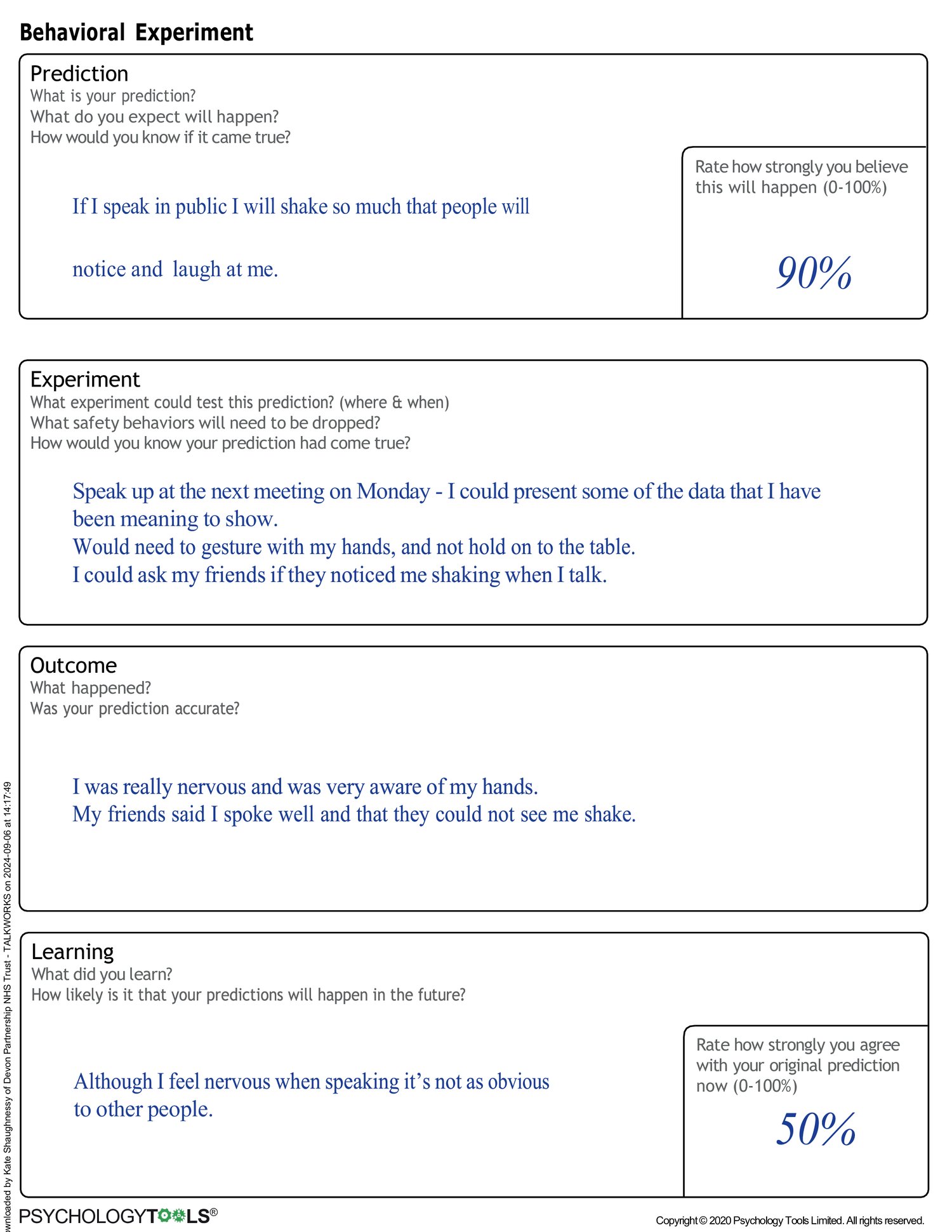
Before completing your own worksheet, take a look at the filled in example below.
This Behavioural Experiment worksheet template comes courtesy of Psychology Tools.
Behavioural Experiment Worksheet
Cognitive Behavioural Therapy
A structured, evidence-based tool to help you test your beliefs, challenge unhelpful thoughts, and build confidence through real-world experience — used as part of your Cognitive Behavioural Therapy (CBT) programme.
🧪 Test
Actively test your beliefs in real life rather than just talking about them
🔍 Observe
Gather direct evidence for or against what you think is true
📊 Compare
Compare your prediction with what actually happened
🌿 Grow
Build confidence and strengthen new, more helpful beliefs
How to Use This Worksheet
Work through each step in order. Rather than just talking about unhelpful beliefs, you will actively test them in real life — gathering direct evidence for or against what you think is true. Think of yourself as a scientist, and your thoughts as hypotheses.
1
Identify the Belief
Name the thought or assumption you want to test. Be as specific and honest as possible — vague beliefs are harder to examine. A good belief statement is specific, behavioural, and falsifiable.
2
Rate Your Belief
Record how strongly you currently believe this thought on a scale of 0–100%. This baseline is essential — you will return to it in Step 6.
3
Design the Experiment
Plan the specific action you will take to test your belief. A well-designed experiment is safe, realistic, and directly relevant to the belief you identified. Discuss your plan with your therapist before proceeding.
4
Predict What Will Happen
Write down exactly what you expect to occur. Use specific, observable terms. This prediction captures your belief in action and gives you something concrete to compare against the actual outcome.
5
Record the Outcome
After carrying out the experiment, record exactly what happened as objectively as possible. Set aside interpretations for now and focus on observable facts.
6
Reflect and Re-Rate
Compare what you predicted with what actually happened, then update your belief rating. Even a small shift in percentage represents a meaningful change in how your mind processes evidence.
🧪 Key Principle: The more specific your prediction, the more useful your experiment. Precise predictions are easier to confirm or disconfirm with real evidence. Never design an experiment that puts you or others at risk — always consult your therapist if you are uncertain.
My Behavioural Experiment
Complete Steps 1–4 Before, Steps 5–6 After
Work through each step in order. Complete Steps 1–4 before carrying out your experiment, then return to complete Steps 5–6 afterwards. Take your time — there are no right or wrong answers.
Step 1 — Identify the Belief
Write the exact thought or assumption you want to test. For example: "If I speak up in a meeting, people will think I'm foolish" or "I cannot cope with uncertainty."
Step 2 — Rate Your Belief
How strongly do you believe this thought right now, before the experiment? 0% = you doubt it entirely. 100% = you feel completely certain it is true.
%
Step 3 — Design the Experiment
Plan the specific action you will take. Be precise about when, where, with whom, and for how long. Discuss your plan with your therapist before proceeding.
01 — Choose a Situation
02 — Define the Action
03 — Set the Conditions
04 — Notes from Your Therapist
Step 4 — Predict What Will Happen
Write exactly what you expect to occur. Use specific, observable terms — avoid vague language like "something bad will happen." Instead try: "People will laugh at me and I will feel humiliated for the rest of the day."
%
Step 5 — Record the Outcome
Complete this section after carrying out your experiment. Record exactly what happened as objectively as possible — as if an outside observer were describing events.
What Happened?
How Did You Feel?
What Did Others Do?
Anything Unexpected?
Step 6 — Reflect and Re-Rate
Compare what you predicted with what actually happened, then update your ratings below.
Before the Experiment
%
%
After the Experiment
%
What did the evidence show?
What would you like to believe instead?
🌿 Remember: There is no such thing as a "failed" experiment. Every outcome — even one that seemed to confirm your original fear — provides valuable information. What matters is that you gathered real evidence rather than relying on assumptions. Well done for taking this step.