


The Principles Behind Exposure
Effective exposure isn't just about "facing your fears." It follows specific principles that make it safe, structured, and therapeutic rather than overwhelming or retraumatising.
Gradual Approach
You don't start with the most feared situation. You start with something manageable and work your way up. This graduated approach ensures that each step is challenging enough to produce learning, but not so overwhelming that it reinforces the fear.
Sustained Contact
Brief, panicked encounters with feared situations don't help — they can actually make things worse, because your brain learns "I was right to be afraid, and escaping was necessary." Effective exposure requires staying in the situation long enough for the anxiety to peak and then naturally decrease. This typically takes anywhere from 20 minutes to an hour, depending on the person and the situation.
Repetition
One exposure isn't enough. Your brain needs multiple experiences of the feared situation going safely before it genuinely updates its threat assessment. Think of it like convincing a cautious friend that a restaurant is good — one positive visit might not be enough, but after the fifth or sixth, they start to believe it.
No Safety Behaviours
Safety behaviours are the subtle things you do to manage your anxiety during a feared situation — gripping the armrest on a plane, keeping your phone in hand at a party, mentally rehearsing your escape route. These behaviours prevent full emotional processing of the experience. If you fly while gripping the armrest and the plane lands safely, your brain concludes: "The armrest grip saved me," not "Flying is safe." Gradually dropping safety behaviours is essential for exposure to work.
Building a Fear Hierarchy
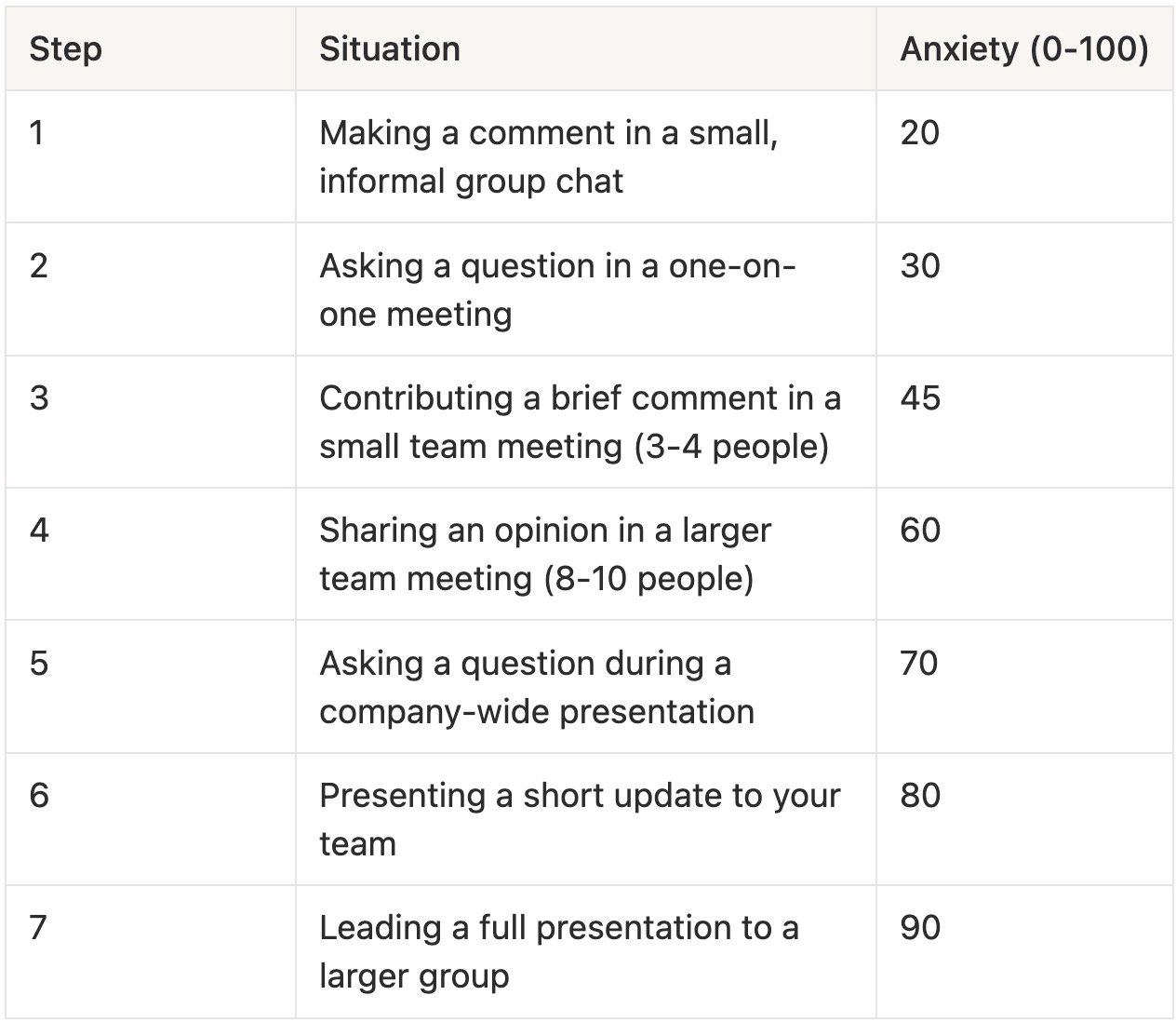
The practical starting point for exposure therapy is a fear hierarchy (sometimes called an "exposure ladder") — a ranked list of situations related to your fear, ordered from least to most anxiety-provoking.
To the right is an example for someone with social anxiety around speaking up in groups. They would begin with step 1 and repeat it until the anxiety rating drops significantly — usually by about half. Then they would move to step 2, and so on.

Types of Avoidance Exposure
Exposure therapy takes several forms, and different types suit different fears.
In Vivo Exposure
This means real-life exposure — actually entering the feared situation. If you're afraid of dogs, you eventually spend time near actual dogs. If you're afraid of lifts, you ride actual lifts. In vivo exposure is the gold standard because it provides the most direct, powerful learning experience.
Imaginal Exposure
For situations that can't easily be recreated in real life — or as a stepping stone before in vivo exposure — imaginal exposure involves vividly imagining the feared scenario in detail. This is commonly used in trauma treatment, where revisiting the actual traumatic situation isn't possible or appropriate.
You describe the feared situation in the present tense, including sensory details and emotional reactions, and stay with the imagery until the anxiety decreases. It sounds simple, but the brain responds to vivid imagery in ways that closely mirror actual experience.

Interoceptive Exposure
This type targets the fear of physical sensations themselves — particularly relevant for panic disorder, where people become afraid of their own bodily responses (racing heart, dizziness, shortness of breath).
Interoceptive exposure deliberately induces the feared sensations in a controlled way. Spinning in a chair to create dizziness. Breathing through a straw to create breathlessness. Running on the spot to raise heart rate. By experiencing these sensations repeatedly in a safe context, you learn that the sensations themselves aren't dangerous — they're just uncomfortable.
Virtual Reality Exposure
Increasingly, virtual reality technology is being used to create realistic simulations of feared situations — heights, flying, public speaking, crowded spaces. This provides a middle ground between imaginal and in vivo exposure, offering a more immersive experience than imagination alone while maintaining a controlled environment.

What Happens During Exposure
Understanding what to expect makes the process much less daunting.
The Anxiety Curve
During exposure, anxiety typically follows a predictable pattern. It rises sharply at first — sometimes to levels that feel almost unbearable. This is the point where every instinct screams at you to leave, to escape, to make it stop.
But if you stay — if you ride the wave instead of running from it — something remarkable happens. The anxiety peaks, plateaus, and then begins to fall. Your nervous system, having sounded the alarm and received no evidence of actual danger, gradually stands down. Heart rate slows. Breathing normalises. The muscles relax.
This natural decline is the core therapeutic mechanism. Your brain learns: "I was in the situation, I stayed, and I was okay. The threat wasn't real." Each time you repeat this experience, the peak gets lower and the decline comes faster.

The First Session Is the Hardest
The most difficult moment in exposure therapy is almost always the first time. The anticipatory anxiety — the dread before you begin — is usually worse than the actual experience. Most people report that once they're in the situation, it's uncomfortable but manageable, and significantly less terrible than they imagined.
Progress Isn't Linear
You'll have good days and bad days. Sometimes a situation that felt manageable last week will feel harder this week. This is normal and doesn't mean you've lost progress. Anxiety fluctuates with stress, sleep, general wellbeing, and countless other factors. The overall trajectory is what matters, not any single session.

Self-Guided Exposure: A Practical Framework
While severe anxiety disorders benefit from professional guidance, many people can apply exposure principles independently for milder fears and avoidance patterns. Here's a practical framework:
Week 1: Build your hierarchy. Identify your fear, brainstorm situations, rate them, and arrange them in order. Don't start any exposures yet — just plan.
Week 2: Begin with the lowest step. Do the exposure at least three times during the week. Before each exposure, rate your predicted anxiety (0-100). During the exposure, stay in the situation until the anxiety drops by at least half. After the exposure, record what actually happened and what you learned.
Weeks 3 onwards: Progress up the ladder. Move to the next step when the current one no longer produces significant anxiety (typically rated 20 or below). Continue repeating each step until it feels manageable before moving on.
Throughout: Keep a log. Record the date, the exposure, your anxiety before and after, and any observations. Over time, this log becomes powerful evidence of your progress — evidence you can return to when your anxious mind tries to convince you that nothing has changed.

Common Concerns About Exposure
"Won't it make my anxiety worse?"
In the short term, exposure increases anxiety — that's the point. But this temporary increase is what produces the long-term decrease. Avoiding the short-term discomfort guarantees that the long-term problem persists. Exposure trades temporary discomfort for lasting freedom.
"What if I can't handle it?"
This is the fear talking — and it's almost always wrong. People consistently overestimate how difficult an exposure will be and underestimate their ability to cope. The fact that you're considering facing your fear is already evidence of strength and capability.
"What if something bad actually happens?"
Good exposure therapy starts with situations where the objective risk is genuinely low. You're not being asked to do something actually dangerous. You're being asked to enter situations that feel dangerous but aren't — and to discover that difference through experience.
"How is this different from just forcing yourself to do things?"
Structure and intention. Exposure therapy is planned, graduated, and reflective. You're not white-knuckling your way through feared situations — you're systematically training your brain to respond differently. The hierarchy ensures you're working at the right level, and the reflection after each exposure helps consolidate the learning.

Key Takeaway
Graded exposure therapy works because it gives your brain what avoidance never can: updated information. When you stay in a feared situation long enough for the anxiety to naturally subside, your brain learns that the threat was smaller than it believed — or not a threat at all.
This learning, repeated over time, fundamentally rewires your fear response. Avoidance feels like protection, but it's actually a trap. Exposure feels like danger, but it's actually the path to freedom.